
Most buyers know the basic story by now: the Federal Reserve does not directly set mortgage rates.
Yet every Fed meeting still dominates mortgage headlines.
Lenders talk about it. Financial media analyzes every word. Buyers wait for the announcement hoping rates will move in their favor.
If the Fed Doesn’t Set Mortgage Rates, What Actually Does?
The answer reveals a deeper truth about how mortgage markets actually work.
The mistake many buyers make is treating mortgage rates as a Fed story.
If you’re new to mortgage financing, start by understanding what a mortgage is and how home loans work. [What Is a Mortgage? How Home Loans Work for First-Time Buyers]
In reality, mortgage rates are a bond market story.
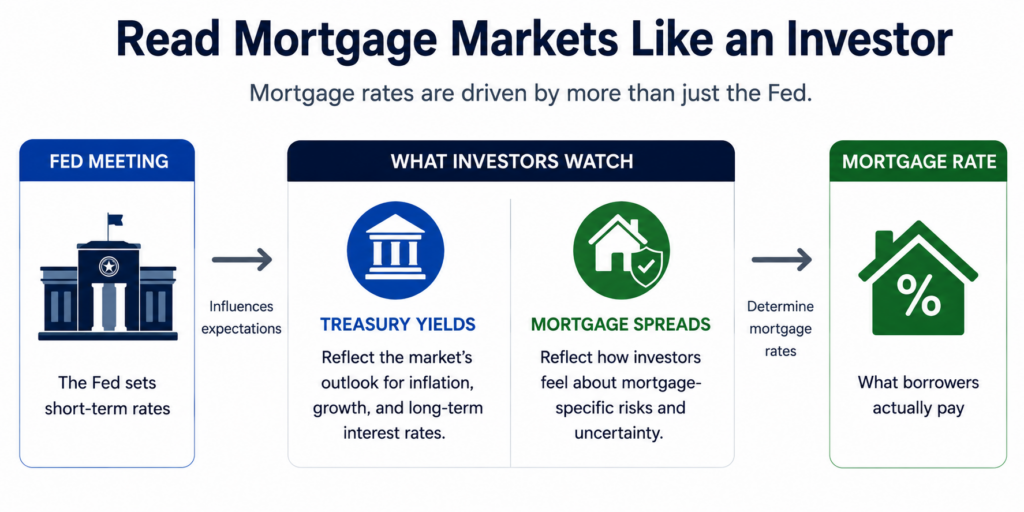
The Fed matters, but not because it directly determines the rate on a 30-year mortgage. It matters because investors use Fed decisions to update their expectations about inflation, economic growth, and future risk. Those expectations influence the bond market, and the bond market is where mortgage rates are ultimately priced.
Understanding that distinction can completely change how you interpret mortgage news.
The Fed Controls One Rate. Mortgage Investors Care About Many Others.
When investors buy mortgage-backed securities (MBS), they are committing capital for years, not days.
As a result, they focus less on the Fed’s current target rate and more on the broader economic outlook. They want to understand where inflation is headed, whether economic growth is likely to slow, how refinancing activity may change, and how much risk they should be compensated for taking.
Those long-term expectations have a much greater influence on mortgage pricing than the federal funds rate itself.
That is why mortgage rates sometimes move before a Fed meeting, sometimes after it, and occasionally in the opposite direction many buyers expect.
The market is not simply reacting to today’s rate decision. It is reacting to what that decision signals about the future.
What Investors Are Really Listening for During a Fed Meeting
Most buyers focus on the announcement itself. Bond investors, however, are often more interested in the message behind it.
For example, imagine the Fed cuts rates by 0.25%. At first glance, that sounds positive for mortgage rates. But investors immediately ask a second question:
Why did the Fed cut?
If investors believe inflation is cooling and the economy is moving toward a stable landing, they may become more comfortable buying long-term bonds. Treasury yields may fall, mortgage spreads may tighten, and mortgage rates may decline.
But if investors believe the Fed is cutting because economic conditions are deteriorating faster than expected, the reaction can be very different. Uncertainty rises. Volatility increases. Investors may demand more compensation for risk.
Mortgage rates may not fall as much as expected.
The same Fed decision can produce different mortgage outcomes because mortgage markets are pricing future expectations, not simply today’s announcement.
That is why experienced market participants often pay more attention to the Fed’s projections, press conference, and economic outlook than to the rate change itself.
Why Mortgage Rates Follow the 10-Year Treasury
Most buyers eventually hear that mortgage rates tend to move with the 10-year Treasury yield.
At first, that may seem counterintuitive. After all, a traditional mortgage can last up to 30 years, so why would investors compare it to a 10-year bond?
The answer lies in how mortgages behave in the real world. Most borrowers do not keep the same mortgage for three decades. They move, refinance, or sell their homes long before the loan reaches maturity.
As a result, investors often view mortgages as assets with an effective lifespan closer to seven to ten years. That makes the 10-year Treasury a useful benchmark for pricing mortgage debt.
As of June 5, 2026, Freddie Mac’s Primary Mortgage Market Survey (PMMS) reported the average 30-year fixed-rate mortgage at 6.48%. During roughly the same period, the 10-year Treasury yield traded near 4.5%.
While those figures move in the same general direction over time, they are rarely identical. Understanding what creates the gap between them is one of the most important concepts in mortgage pricing.
The Metric Most Buyers Never Watch: Mortgage Spreads
The difference between mortgage rates and Treasury yields is known as the spread.
In simplified terms:
Mortgage Rate − 10-Year Treasury Yield = Mortgage Spread
Using the figures above:
- Mortgage rate: 6.48%
- Treasury yield: 4.50%
Spread ≈ 1.98%
Many buyers stop there.
But the spread is more than a math exercise. It is one of the clearest windows into how investors feel about mortgage risk.
A wider spread often means investors want additional compensation for uncertainty.
That uncertainty may include:
- Interest rate volatility
- Refinancing behavior
- Liquidity conditions
- Demand for mortgage-backed securities
In other words:
A mortgage rate is not just the cost of money.
It is also the price of uncertainty.
This is why two periods with similar Treasury yields can produce very different mortgage rates.
The missing variable is often the spread.
A Framework for Reading Mortgage Markets Like an Investor
Instead of asking whether the Fed raised or cut rates, try asking two different questions.
Lens 1: What happened to Treasury yields?
Treasury yields reflect the market’s outlook for inflation, growth, and long-term interest rates.
Lens 2: What happened to mortgage spreads?
Mortgage spreads reflect how investors feel about mortgage-specific risks and uncertainty.
Together, these two lenses provide a more useful framework than Fed headlines alone.
| Treasury Yield | Mortgage Spread | Likely Mortgage Impact |
|---|---|---|
| Down | Down | Strongly favorable |
| Down | Up | Mixed outcome |
| Up | Down | Mixed outcome |
| Up | Up | Less favorable |
Consider a simple example.
Assume:
- 10-year Treasury = 4.50%
- Mortgage spread = 2.00%
Mortgage rate ≈ 6.50%
Now assume the Treasury yield stays exactly the same, but investor confidence improves and the spread narrows to 1.50%.
Mortgage rate becomes:
4.50% + 1.50% = 6.00%
Mortgage rates fall by approximately 0.50% even though the Fed did nothing and Treasury yields did not move.
That is the kind of market dynamic many buyers miss when they focus exclusively on Fed meetings.
The Better Way to Interpret Fed News
Fed meetings deserve attention, but they should be viewed as signals rather than direct pricing events.
While the Fed influences the broader economic outlook, mortgage rates are ultimately shaped by how investors interpret inflation, growth, and risk.
That is why mortgage rates sometimes move with Fed decisions, sometimes ignore them, and sometimes appear to react in unexpected ways.
The next time a Fed meeting dominates the headlines, look beyond the rate announcement itself. Watch Treasury yields. Watch mortgage spreads.
Because the most important mortgage story is rarely what the Fed did. It is how the bond market interpreted what the Fed said.
FAQs
Does the Fed Directly Set Mortgage Rates?
No. The Federal Reserve sets the federal funds rate, which influences short-term borrowing costs. Mortgage rates are primarily determined by bond markets, investor expectations, Treasury yields, and mortgage-backed securities. This is why mortgage rates can move independently of Fed rate decisions.
Why Do Mortgage Rates Change After Fed Meetings?
Mortgage rates often change after Fed meetings because investors reassess expectations for inflation, economic growth, and future interest rates. The market reaction to the Fed’s outlook can have a greater impact on mortgage rates than the actual rate decision itself.
What Affects Mortgage Rates the Most?
Several factors influence mortgage rates, including Treasury yields, inflation expectations, mortgage spreads, and investor demand for mortgage-backed securities. While Fed policy plays a role, long-term market expectations are often more important than a single Fed meeting.
Why Do Mortgage Rates Follow the 10-Year Treasury?
Mortgage rates tend to move with the 10-year Treasury yield because most mortgages are paid off, refinanced, or sold long before 30 years pass. As a result, investors often use the 10-year Treasury as a benchmark when pricing mortgage-backed securities.
Should You Wait for a Fed Rate Cut Before Buying a Home?
Not necessarily. A Fed rate cut does not guarantee lower mortgage rates. In some cases, mortgage rates may already reflect expected Fed actions before the announcement occurs. Buyers should evaluate affordability, market conditions, and personal financial readiness rather than relying solely on Fed meetings.
Wonder Rates NMLS #1518655. Equal Housing Lender.
For educational purposes only. Not a commitment to lend. Rates and terms subject to change. Mortgage rates and APRs vary by borrower profile, loan type, lender pricing, and market conditions. For information specific to your situation, consult a licensed Loan Officer.