Category: Rate Lock

  • When Your Rate Lock Expires Before Closing

    When a rate lock expires before closing, buyers may face unexpected fees or even a higher mortgage rate.

    You locked your rate, exhaled, and mentally moved on.

    Then your closing got pushed back three weeks.

    That exhale just cost you $1,000.

    A rate lock is not a safety net you can sit on indefinitely. It has an expiration date, usually 30, 45, or 60 days from the day you locked. Miss that window, and you’re looking at extension fees, or floating back to whatever the market is doing that morning.

    rate lock expires before closing

    What Happens When a Rate Lock Expires Before Closing

    Market risk is easy to obsess over. Timeline risk is the one that tends to surprise people.

    A buyer can spend weeks watching mortgage rate headlines while their builder has already missed two completion dates. A delayed appraisal, an unexpected title issue, or a last-minute underwriting request can push closing past your lock window even when rates barely move.

    The real question is not just “where will rates go?” It’s also “Will this loan close before my lock expires?”

    Why Closings Run Late

    Four culprits show up again and again.

    Appraisal delays. One backlogged appraiser can push your whole timeline by a week or more.

    Title issues. Unpaid liens or ownership gaps can hold up closing while the title company works through them. Hard to predict until it’s already happening.

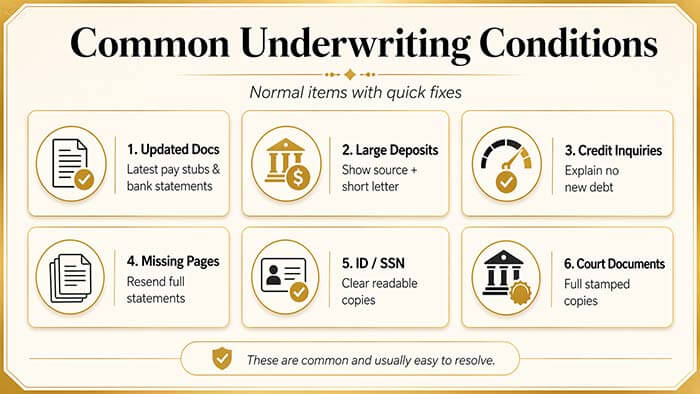
    Underwriting conditions. You think the file is clear. Then your lender circles back asking for updated pay stubs or a letter of explanation. That round trip costs time.

    If you’re applying with another person, last-minute documentation requests can create even more delays. Before starting the process, make sure you understand the difference between a co-borrower and co-signer.

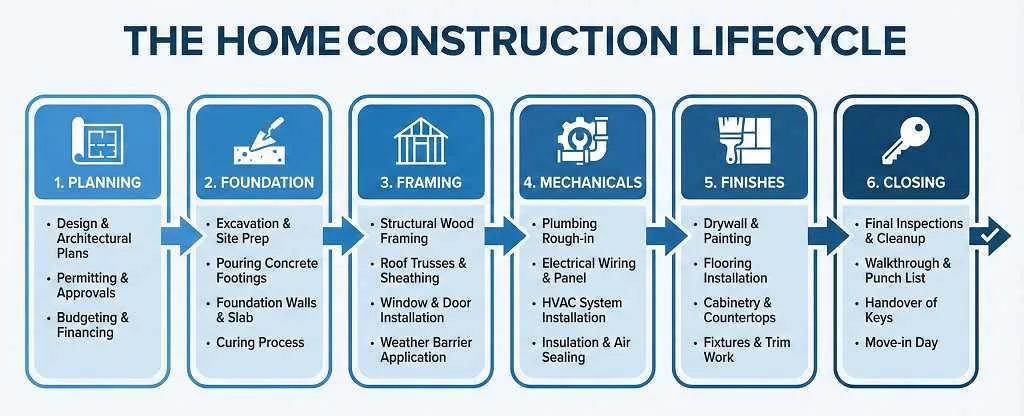
    New construction. Builder timelines are estimates, not guarantees. A 30-day lock on a home that is “almost done” is almost always too short.

    Any of these delays can increase the chance that a rate lock expires before closing.

    What Happens When the Clock Runs Out

    Two options. Neither is free. When a rate lock expires before closing, borrowers typically need to extend the lock or accept current market rates.

    Extend the lock. Your lender grants more time but charges for it. Typical ranges (illustrative only; actual fees vary by lender):

    • 7 to 15 days: 0.125 to 0.25 points per extension period
    • 15 to 30 days: 0.25 to 0.375 points, sometimes more
    • Some lenders charge a daily rate: roughly 0.02% to 0.03% of the loan amount per day.

    On a $500,000 loan, a 0.25-point extension fee is $1,250. Two rounds and you’re at $2,500 before you’ve made a single mortgage payment.

    Float back to market. Let the lock expire and renegotiate at whatever rate is available that day. If rates moved up while you waited, you absorb the full increase.

    If you’re comparing loan options, it’s also worth understanding how FHA mortgage insurance can affect your monthly payment and long-term costs.

    Fee ranges above are illustrative. Your lender’s actual costs will differ. Ask before you lock.

    Short Lock vs. Long Lock

    Run this comparison before you choose a lock period.

    30-Day Lock 45-Day Lock 60-Day Lock
    Typical upfront cost Lower or free +0.125 to 0.25 pt +0.25 to 0.375 pt
    Buffer for delays Very little Moderate More room
    If closing is on time Paid nothing extra Paid for unused days Paid more for unused days
    If closing slips Extension fee or re-lock Smaller exposure Smallest exposure

    The math question: What does a longer lock cost upfront vs. what does an extension cost later?

    On a $400,000 loan:

    • Locking 15 extra days at 0.125 point upfront = $500
    • One extension round at 0.25 point = $1,000

    If there’s a real chance of a meaningful delay, a longer lock may end up being the less expensive option.

    But don’t default to always going longer. A 60-day lock on a clean resale with no title complications may mean paying 0.375 point for insurance you never needed. On a $400,000 loan, that’s $1,500 for nothing.

    The right call depends on your transaction type, your lender’s timeline, and where you think the risk actually sits.

    Who Pays the Extension Fee?

    It depends on who caused the delay.

    Buyer-side delay (slow on documents, financing changes): buyer typically picks up the tab.

    Seller-side delay (title issues, not vacating on time): sometimes negotiable, may come out of closing credits.

    Lender-side delay (underwriting backlog, internal slowdowns): some lenders absorb the cost. Ask whether that’s their policy before you go under contract, not the morning your lock is about to expire.

    The One Question to Ask Before You Lock

    “Given this specific transaction, what lock period makes sense, and what would an extension cost if closing slips by two weeks?”

    That gets you a real number. Then you can decide whether locking longer upfront is worth it.

    A rate lock buys certainty. Just make sure the window is long enough to use it.

    Most buyers watch rate headlines and ignore timeline risk. Those are two different problems, and timeline risk is the one that actually catches people off guard.

    Rates, fees, and terms above are illustrative examples only and subject to change without notice. This is not a commitment to lend. Subject to credit approval. Wonder Rates | NMLS#: 1518655 | Equal Housing Lender

  • Lock or Float? Here’s the Framework That Replaces the Guesswork

    Lock or Float? Here’s the Framework That Replaces the Guesswork

    Lock or float? Nobody can predict rates. But you can calculate the risk.

    Here’s a 4-input framework to decide.

    The lock-or-float choice isn’t a market prediction. It’s a risk calculation.

    Locking buys certainty: your lender locks a rate for a set window (commonly 30, 45, or 60 days). Floating keeps your options open. If rates drop before closing, you gain. If they rise, you end up paying more.

    The market doesn’t know your closing date or budget. This framework helps you weigh the variables that actually matter.

    Lock or Float: What Are You Actually Deciding?

    Most buyers ask: “Where are rates going?” That is the wrong question.

    The right one: “If I am wrong, what does it cost me?”

    A prediction asks you to be right. A risk calculation asks you to be prepared. The framework below helps you do the second one.

    The four inputs that actually matter

    1. Time to closing

    This is your first question. How many days stand between now and your closing date?

    A longer float window means more exposure to rate movements. The more time you spend unprotected by a rate lock, the more opportunities there are for rates to move against you. While the relationship is not perfectly linear, a longer timeline generally means greater uncertainty and a wider range of possible outcomes.

    A useful mental model: think of your time horizon in quarters. Under 30 days is one zone. Thirty to 45 is another. Over 45 days is a third, and it carries more uncertainty meaningfully.

    2. Your breakeven on a rate move

    Here is the concrete math. Say you are financing $450,000.

    A 0.25% rate increase on a 30-year mortgage typically adds about $17 per month for every $100,000 borrowed.

    Calculation:

    $17 × 4.5 = about $77 more per month

    Over 12 months:

    $77 × 12 = about $924 more per year

    If floating is free (some lenders charge a float-down fee; we’ll talk about that later), and you close in 45 days, your downside is about $804 each year. This continues for the life of that rate, starting now. Ask yourself: how much would rates need to fall for the monthly savings to feel worth carrying that risk?

    The math is symmetric. A 0.25% drop saves you the same $67/month. But the psychological experience is not symmetric. Research on financial decision-making shows that losses hurt more than gains. Losses hit harder. That asymmetry is worth naming because it will influence your gut reaction, whether you acknowledge it or not.

    3. Your actual risk tolerance, not the hypothetical one

    There is a difference between how you think you handle uncertainty and how you actually handle it at 11 p.m., watching mortgage news.

    A useful question: if rates rose 0.375% tomorrow and you had been floating, would you sleep fine? Or would you spend the next three weeks second-guessing the decision and checking rates daily?

    If the honest answer is the second one, that is not a weakness. It is a data point. Certainty has real value when you are already carrying the stress of a home purchase. The “cost” of locking is not just the rate itself. It also includes what you give up by closing the optionality. For some buyers, that optionality is worth very little because the mental overhead of monitoring it is too high.

    4. The float-down option, if your lender offers it

    Some lenders have a float-down provision. You lock in your rate today, but if rates drop by a set amount before closing, you can negotiate for the lower rate. This product costs something, either as a fee or baked into a slightly higher rate.

    Before assuming floating is your only way to capture a rate drop, ask whether a float-down is available. Run the math on the fee versus your probability-weighted downside exposure.

    Example: if a float-down costs 0.125% of the loan amount on a $450,000 loan, that is $562.50. If you believe there is a 30% chance that rates fall 0.25%, your expected monthly savings would be about $20/month. The float-down breaks even after roughly 28 months. Whether that is worth it depends on how long you plan to hold the loan.

    What moves rates in your lock window

    You do not need to become a bond trader. Knowing what drives rate changes in 30 to 60 days helps you tell if the environment is calm or volatile.

    Mortgage rates track closely with 10-year Treasury yields, which respond most sharply to:

    • Inflation data (CPI and PCE releases)
    • Federal Reserve meeting decisions and Chair statements
    • Job reports (strong employment tends to push rates up)
    • Major geopolitical or financial market disruptions

    If several of these events fall inside your lock window, you are floating through more market noise than if your window is quiet. Your loan officer can tell you what economic calendar events fall between now and your closing date. That’s a good question to ask. The answer should shape your thoughts.

    The framework as a decision map

    Put the four inputs together, and you get a way to think through your own situation:

    • Short window, low volatility calendar, high stress tolerance → the case for floating is more manageable
    • Long window, volatile calendar, limited budget buffer → the value of locking certainty increases
    • Somewhere between → that is where the float-down conversation becomes worth having

    None of these combinations tells you what to do. They tell you what you are trading. That is the point.

    A locked rate is not a loss if rates stay flat or rise. A floated rate is not a win if rates drop, but you spent six weeks anxious. The goal is a decision you can commit to with clear reasoning, not one you will revisit every morning until closing.

    One last thing to audit

    Before you finalize your thinking, confirm one number with your lender: the exact cost, if any, of extending your lock if closing gets delayed. Delays happen, and a rate lock extension can cost 0.125% to 0.375% of the loan depending on the lender and how long the extension runs. If your transaction has any complexity, factor that cost into the analysis before you assume a shorter lock is always cheaper.

    The lock-or-float decision is not a market call. It is a personal risk calculation with four inputs: your time to closing, your breakeven on a rate move, your honest stress tolerance, and the cost of any float-down option available to you. Run those four numbers against your situation, and the decision gets a lot clearer than checking the headlines.

    WonderRates NMLS #1518655 | Equal Housing Lender.

    This article is for educational purposes only and does not constitute financial or mortgage advice. Mortgage rates, loan terms, and lender policies vary and are subject to change. Consult a licensed loan officer to evaluate the options that fit your specific transaction and financial situation.

  • Your Rate Lock Is a Clock, Not a Guarantee: What Happens If It Expires Before Closing?

    Your Rate Lock Is a Clock, Not a Guarantee: What Happens If It Expires Before Closing?

    Your rate lock is a clock, not a guarantee

    Many homebuyers think the hardest part of getting a mortgage is finding a home and locking a rate. Once the rate is locked, it feels like one major uncertainty has been removed from the process.

    In reality, a rate lock is not a permanent guarantee. It comes with an expiration date.

    The goal is not to assume every transaction will be delayed. The goal is to understand the trade-offs before choosing a lock term.

    NMLS #1518655

    What a rate lock actually does

    A rate lock helps protect you from rising interest rates for a set period of time, typically 30, 45, or 60 days.

    If your loan closes before the lock expires, you can generally keep the rate you locked, provided your loan application doesn’t change significantly and you continue to meet the lender’s requirements.

    But if your closing is delayed and the lock expires, you may face one of two outcomes:

    • You pay a fee to extend your rate lock; or
    • Your loan is re-priced using current market rates.

    Which outcome applies depends on your lender’s policies, market conditions, and the reason for the delay.

    rate-lock-is-a-clock
    What a rate lock actually does ?

    Why closings get delayed more often than buyers expect

    Many delays happen for reasons that have little to do with the borrower.

    Appraisal delays

    Appraisal scheduling can become difficult during busy market periods. If the appraisal report arrives later than expected, underwriting timelines may shift.

    Title issues

    Title companies occasionally uncover unresolved liens, ownership questions, or documentation problems that must be addressed before closing.

    Underwriting conditions

    An underwriter may request additional documentation, updated bank statements, employment verification, or explanations for financial transactions.

    Each request can add days to the timeline.

    rate-lock-is-a-clock
    Underwriting conditions

    New construction timelines

    New construction transactions frequently experience scheduling changes.

    Weather delays, labor shortages, permit approvals, utility connections, and final inspections can all push the closing date beyond the original estimate.

    This is one reason many buyers of newly built homes evaluate longer lock periods from the start.

    rate-lock-is-a-clock.jpg12
    New construction timelines

    Who pays for a lock extension?

    The answer depends on the circumstances.

    There is no universal rule that applies to every lender or every transaction.

    A useful framework is to identify the source of the delay.

    New construction timelines
    Your Rate Lock Is a Clock, Not a Guarantee

    Scenario 1: Borrower-caused delay

    Examples include:

    • Late documentation
    • Changes to employment information
    • Delayed responses to underwriting requests
    • Requests to postpone closing

    In these situations, extension costs are often the borrower’s responsibility.

    Scenario 2: Lender-caused delay

    Examples include:

    • Internal processing delays
    • Underwriting bottlenecks
    • Operational issues within the lender

    Some lenders may absorb certain extension costs when the delay is clearly attributable to their process.

    Scenario 3: Third-party delay

    Examples include:

    • Appraisal scheduling
    • Title work
    • Government recording offices
    • Builder delays

    Responsibility varies by lender policy and transaction structure.

    The important takeaway is that borrowers should understand extension policies before locking rather than after a delay occurs.

    A simple framework: Compare expected cost, not just upfront cost

    Many borrowers focus only on the cheapest lock period available.

    A more useful approach is to compare total expected cost.

    Consider the following illustrative example.

    Option A: 30-day lock

    Assume:

    • Loan amount: $400,000
    • 30-day lock cost: $0
    • Probability of needing a 15-day extension: 30%
    • Extension fee: 0.125 points

    Extension cost:

    • 0.125% × $400,000 = $500

    Expected extension cost:

    • $500 × 30% = $150

    Expected total cost:

    • $0 + $150 = $150

    Option B: 45-day lock

    Assume:

    • Additional upfront lock cost: 0.05 points

    Cost:

    • 0.05% × $400,000 = $200

    Expected total cost:

    • $200

    Option C: 60-day lock

    Assume:

    • Additional upfront lock cost: 0.10 points

    Cost:

    0.10% × $400,000 = $400

    Expected total cost:

    $400

    In this example, the 30-day lock has the lowest expected cost.

    However, if the probability of delay rises significantly, the comparison can change. The lesson is not that one option is always superior. The lesson is that lock duration should be evaluated using both cost and timeline risk.

    Understanding extension fees

    Extension pricing varies significantly by lender and market conditions.

    Illustrative examples often include:

    • Approximately 0.02% to 0.05% of the loan amount per day, or
    • Approximately 0.125 to 0.25 discount points per extension period

    These figures are examples only and may not reflect current lender pricing.

    Actual costs can differ materially based on loan program, lock term, market conditions, and lender policy.

    For that reason, borrowers should request specific extension pricing information before selecting a lock period.

    A Better Conversation Than “What’s the Rate?”

    Instead of asking only, “What is today’s rate?”, consider asking:

    1. How long is the lock period?
    2. What is the extension policy?
    3. How are extension fees calculated?
    4. What delays are most common for this transaction?
    5. Does a new construction property create additional timeline risk?
    6. What are the costs of 30-, 45-, and 60-day lock options?

    These questions often provide more useful information than rate alone.

    Final Thought

    Example rate, fee, APR, and cost figures in this article are hypothetical and provided solely for educational purposes. They do not represent a commitment to lend, a loan approval, or current market pricing.

    Disclaimer: Wonder Rates NMLS #1518655 Equal Housing Lender Rates and terms subject to change. This article is for educational purposes only and should not be considered financial, tax, or legal advice.