Tag: EN

  • 10-Step Home Buying Process for First-Time Buyers

    10-Step Home Buying Process for First-Time Buyers

    Learn the 10-step home buying process for first-time buyers in the US. Understand timelines, key players, and what to expect at every stage.

    NMLS#: 1518655

    Buying your first home in the US can feel confusing when every step sounds new and high-stakes.

    If you’re not sure where to start or how long it takes, you’re not alone. Most first-time buyers go through the same questions. This guide breaks the process into 10 clear steps, so you know what happens, who is involved, and how to move forward with confidence. Understanding the home buying process helps first-time buyers avoid surprises.

    Timeline at a glance (10 steps)

    • Budget planning: 1 to 2 days
    • Pre-approval: 1 to 3 days
    • Find a real estate agent: 1 to 3 days
    • House hunting: 1 to 8 weeks
    • Make an offer: 1 to 3 days
    • Under contract: 1 to 2 days
    • Open escrow, title, and earnest money: 1 to 3 days
    • Home inspection: 3 to 7 days
    • Appraisal (ordered by lender): 3 to 7 days
    • Underwriting to clear to close and closing: 2 to 3 weeks

    Estimated total timeline: 3 to 6 months Contract to closing: 30 to 45 days (according to NAR)

    Home Buying Process: The 10 Steps to Buy a Home
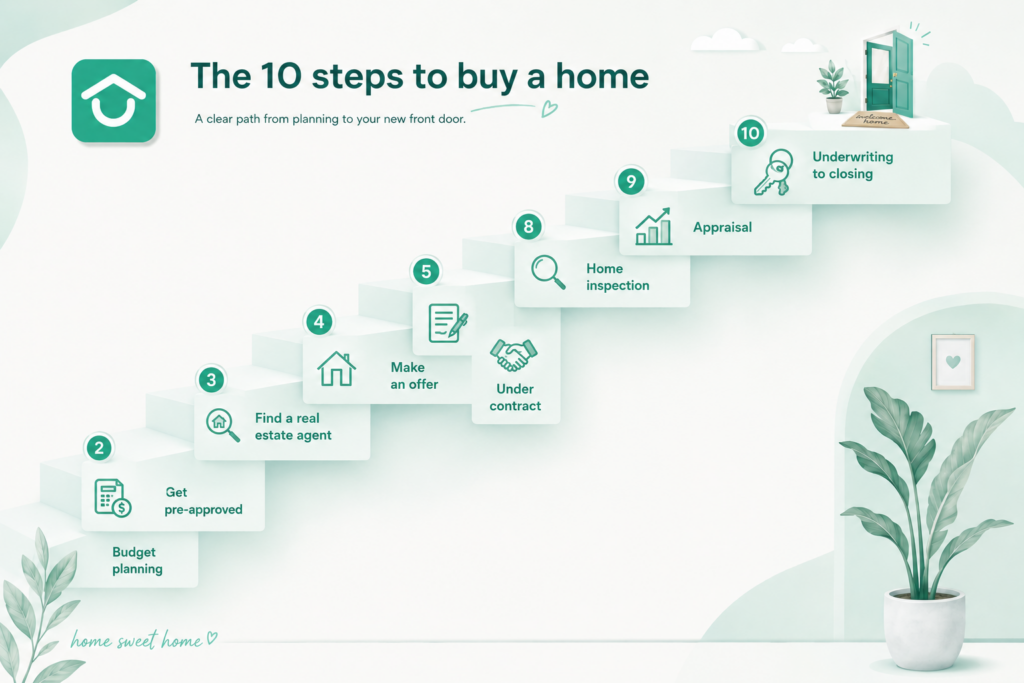
    Infographic showing the 10 steps to buy a home, from budget planning and pre-approval to closing.


    1. Budget planning

    Who: You, lender

    Time: 1 to 2 days

    You start by reviewing your income, debt, and savings. A lender estimates your monthly payment using PITI, which includes principal, interest, taxes, and insurance.

    Tip: Focus on monthly affordability, not just the home price.

    2. Get pre-approved

    Who: You, lender

    Time: 1 to 3 days

    The lender reviews your credit, income, and debt to issue a pre-approval letter. This shows sellers you are serious and ready. If you’re not familiar with mortgage basics, understanding how mortgages work can make the pre-approval process much easier.

    Tip: Avoid big purchases during this stage to keep your profile stable.

    3. Find a real estate agent

    Who: You, real estate agent

    Time: 1 to 3 days

    Your agent helps you find homes, schedule tours, and guide negotiations. They also explain local market conditions.

    Tip: Choose someone responsive and experienced with first-time buyers.

    4. Start house hunting

    Who: You, agent

    Time: 1 to 8 weeks

    You visit homes that match your needs, budget, and location. You compare options before making a decision.

    Tip: Prioritize must-haves over nice-to-haves to avoid decision fatigue.

    House hunting illustration with a for-sale home

    5. Make an offer

    Who: You, agent, seller

    Time: 1 to 3 days

    You submit an offer that includes price and contingencies, such as inspection and financing.

    Tip: A strong but realistic offer can improve your chances in a competitive market.

    6. Under contract

    Who: You, seller, agent

    Time: 1 to 2 days

    Once the seller accepts your offer, both sides agree on terms. The deal moves forward but is not final yet.

    Tip: Read your contract carefully so you understand all deadlines.

    7. Open escrow and title

    Who: You, escrow company, title company

    Time: 1 to 3 days

    A third party holds funds and documents. You deposit earnest money, usually 1% to 3% of the home price. A title search checks for ownership issues.

    Tip: Earnest money can later be applied toward your down payment.

    8. Home inspection

    Who: You, home inspector

    Time: 3 to 7 days

    You hire an inspector to evaluate the home’s condition. This helps you uncover issues before closing.

    Tip: Use inspection results to renegotiate or request repairs if needed.

    9. Appraisal

    Who: Lender, appraiser

    Time: 3 to 7 days

    The lender orders an appraisal to confirm the home’s value. This protects both you and the lender.

    Tip: A low appraisal does not end the deal, but you may need to renegotiate.

    10. Underwriting to closing

    Who: Lender, underwriter, you, seller

    Time: 2 to 3 weeks

    The lender reviews all documents. If approved, you receive clear to close. At closing, you sign the loan documents, and the seller signs the deed.

    Tip: Do not change jobs or open new credit before closing.

    Common mistakes to avoid

    Understanding the home buying process can help you avoid costly mistakes. Many first-time buyers confuse pre-qualification with pre-approval, which can weaken their offer. Others underestimate total costs, including taxes, insurance, and closing fees. Some skip inspection contingencies to win deals, which can lead to costly repairs later. Another common issue is misunderstanding roles. The buyer does not sign the deed at closing, and appraisal is ordered by the lender, not the buyer. Knowing these details helps you avoid delays and surprises.

    How to take action

    The home buying process becomes much easier when you follow a clear checklist. Start by talking to a lender early to understand your budget and loan options. Then, work with a real estate agent who knows your local market. Build a clear checklist for each step and track deadlines carefully.

    Most importantly, take your time to understand each stage. Buying a home is a major decision, and being informed helps you avoid stress and make better choices.

    first-time home buying process and mortgage paperwork

    Bottom line

    While the home buying process may seem complex at first, knowing each step helps you move forward confidently.

    Want to see what you can afford? Talk to a licensed loan officer to explore your options.

    Home Buying Process FAQs

    How long does the home buying process take?

    The process typically takes 3 to 6 months, depending on your financial readiness and local market conditions.

    What is the first step in the home buying process?

    Most buyers start by reviewing their budget and obtaining a mortgage pre-approval.

    Do I need a real estate agent to buy a home?

    While not required, an experienced agent can help navigate negotiations, contracts, and local market conditions.

    DISCLAIMER:

    Wonder Rates NMLS# 1518655. Equal Housing Lender. Information is for educational purposes only and is not a commitment to lend.


  • Same Budget, Two Paths: Buy Down the Rate or Buy Down the House?

    Same Budget, Two Paths: Buy Down the Rate or Buy Down the House?

    Asking the seller to cut the price feels like the obvious win. Most buyers stop there. But the same $12,000 in leverage can work very differently depending on where it goes. Here is the comparison most people never run.

    Why a Lower Purchase Price Is Not Always the Biggest Win

    When you negotiate a price reduction, that savings does not flow one-for-one into your loan. If you are putting 20% down, only 80% of the price cut reduces your loan balance. The other 20% becomes extra down payment.

    On a $400,000 home with 20% down, a $12,000 price cut brings your loan from $320,000 to $310,400, a reduction of $9,600. Your interest rate, applied to that entire remaining balance, stays exactly where it was.

    That is the part most people miss. The rate is not touched. Only a fraction of the principal is.

    What Discount Points Actually Buy

    One discount point equals 1% of your loan amount, paid upfront at closing. In exchange, the lender reduces your interest rate for the life of the loan.

    The exact reduction per point varies by lender and changes with market conditions. Confirm the trade-off on your lender’s current rate sheet before running any math. A commonly referenced rule of thumb is roughly 0.25% per point, but your actual pricing may be higher or lower.

    The Consumer Financial Protection Bureau provides a useful reference: on a $180,000 loan, paying 0.375 points ($675 upfront) reduced the rate enough to save approximately $14 per month. The monthly savings may look small at that scale, but the impact grows on a larger loan.

    Note that the note rate and APR are not the same thing. APR includes certain fees and costs associated with the loan and will be disclosed in your Loan Estimate.

    The One Calculation Most Buyers Skip

    Before comparing a price reduction with a rate buydown, calculate the breakeven point: the month when cumulative monthly savings fully recover the upfront cost.

    Breakeven formula: Breakeven (months) = Upfront cost / Monthly savings

    Assumptions for this example:

    • Loan amount: $320,000
    • Term: 30-year fixed
    • Starting note rate: 6.48% (Freddie Mac PMMS, week ending June 4, 2026)
    • Seller concession applied to points: $12,000, equal to 3.75 points
    • Assumed rate reduction: 0.25% per point (illustrative; your lender’s actual pricing will differ)
    • Reference hold period: 7 years

    At 0.25% reduction per point, 3.75 points brings the rate from 6.48% down to approximately 5.54%.

    Scenario Note Rate Monthly P+I
    No points 6.48% $2,018
    3.75 points 5.54% $1,825

    Monthly savings: $2,018 minus $1,825 = $193

    Breakeven: $12,000 / $193 = 62 months, or about 5.2 years

    Hold the loan past that point and every month after returns $193. Over a 7-year hold, savings beyond breakeven total roughly $4,000.

    (All figures are principal and interest only. Your APR will differ from the note rate and will be disclosed in your Loan Estimate.)

    The Same $12,000, Side by Side

    Price Reduction Rate Buydown
    Seller contribution $12,000 $12,000
    Monthly savings About $60 About $193
    Loan balance reduced Yes No
    Interest rate reduced No Yes
    Breakeven required No Yes, about 5.2 years

    Two strategies, same budget, very different monthly results. Here is why.

    A price reduction shaves $12,000 off the purchase price. With 20% down, only 80% of that flows into your loan balance. Your rate stays at 6.48% (Freddie Mac PMMS, week ending June 4, 2026), applied to a slightly smaller number.

    A rate buydown applies that same $12,000 directly against the percentage the lender charges on your entire balance. Every dollar of the $320,000 loan gets cheaper, for every month you hold it.

    That is the gap between $60 and $193 a month. Not the size of the investment. The target it hits.

    One practical note: seller concession caps vary by loan type and are set by lender guidelines for the current cycle. Confirm the applicable cap for your loan type with your loan officer before structuring an offer.

    Where Lender Credits Fit Into the Picture

    Lender credits work in the opposite direction. Instead of paying more upfront to lower the rate, you accept a higher rate and receive assistance with closing costs.

    This can reduce the cash required at closing, but it typically increases the monthly payment. That is why “no closing costs” does not mean no cost. The expense is shifted from closing day to future interest payments over the life of the loan.

    Whether that trade-off makes sense depends on your expected time in the home, available cash reserves, and future refinance plans.

    Three Questions Worth Asking Your Loan Officer

    The numbers above are illustrations. Your actual breakeven depends on your loan amount, your lender’s pricing per point today, and your realistic hold period.

    Before comparing options, ask your loan officer:

    1. What is the current cost and rate reduction available per discount point on today’s rate sheet?
    2. What is the breakeven period for my specific loan scenario and hold timeline?
    3. What seller concession limits apply to my loan program under current guidelines?

    Your loan officer can model all three scenarios against your real numbers. That comparison is what an informed decision looks like.

    A lower purchase price and a lower interest rate are not the same thing, even when they use the same dollar amount. The rate buydown reaches every dollar of the loan balance. The price cut reaches only a fraction of it. Start by asking your loan officer to run the breakeven on your actual numbers. The most common mistake is choosing based on the headline dollar figure rather than the monthly impact over your real hold period.

    Ready to compare your options? Talk to a licensed Wonder Rates loan officer at https://wonderrates.com/contact/. No pressure, just clarity.

    Wonder Rates NMLS#844897. Equal Housing Lender. This is not a commitment to lend. Rates and terms subject to change. Subject to credit approval. Information is for educational purposes only.

  • What Does a Loan Officer Do? The Role Most Homebuyers Misunderstand

    What Does a Loan Officer Do? The Role Most Homebuyers Misunderstand

    What does a loan officer do during the homebuying process?

    Many first-time buyers assume loan officer simply helps them fill out paperwork. In reality, a loan officer guides your mortgage application from pre-approval through closing and plays a critical role in keeping the process on track.

    NMLS#: 2469443 | Equal Housing Lender | Educational content only

    Nobody tells you this before you buy your first home: the person guiding you through the biggest financial decision of your life gets paid nothing if your loan does not close.

    Not a reduced fee. Not an hourly rate. Nothing.

    Sound familiar? Most people have never thought about that side of the job. Once you do, the loan officer’s role starts to make a lot more sense.

    What Is a Loan Officer?

    A loan officer is a licensed mortgage professional who helps you apply for a home loan. They explain loan programs, review your finances, collect required documents, and help prepare your application.

    For most first-time buyers, a loan officer is the first mortgage professional you talk to. Before you start looking at homes, they help you figure out your budget and which loan fits your situation.

    One thing they do not do: approve the loan. They do not set home prices either, and they cannot promise you will qualify. Those limits matter, and we will come back to them.

    A Loan Officer Is Not a Salesperson

    It is easy to assume their job is to sell you something. The structure of the industry says otherwise.

    Under CFPB Regulation Z (12 CFR 1026.36), a loan officer cannot be paid more for putting you in a higher interest rate. Compensation is tied to the loan amount, not the rate. That removes the most obvious financial reason to push you toward a worse deal.

    There is still a real incentive at work, but it runs in your favor. If the loan does not close, the loan officer earns nothing. That creates a direct stake in getting your file approved and keeping the process moving. 80%~75%$ of pipeline work at any given time may be on files that will not close soon pre-approvals, files prepping months out, or deals still in early stages (industry estimate; figures vary by lender and market)Average pull-through rate on a healthy pipeline (MBA industry benchmark; figures vary by lender and market). Earned on any file that does not fund, regardless of hours put in

    “Do not ask how many loans a loan officer closes per month. Ask what percentage of their pipeline actually funds. That number tells you far more about how they work.”

    Note: the 80% and ~75% figures measure different things. The 80% reflects how much pipeline work is tied to files not yet closing. The ~75% pull-through rate reflects how many files that enter the pipeline eventually fund. A loan officer with a 75% pull-through rate still spends meaningful time on the 25% that do not close and earns nothing on those files.
    That is not a salesperson. That is someone with real skin in the game.

    What Does a Loan Officer Do?

    Most of the work is invisible to you. On a typical file, your loan officer reviews documents, answers questions, coordinates with the processor and underwriter, and tracks the loan from application to closing.

    Their core responsibilities: reviewing your income, assets, debts, and credit; explaining loan programs that fit your situation; collecting required documents; providing legally required disclosures; and resolving anything that could block or delay your closing.

    Their goal is not to approve the loan. Their goal is to move the file forward while staying inside the rules.

    Where a Loan Officer Fits in the Timeline

    • Before you start house hunting. Your loan officer reviews your finances and may issue a pre-approval letter if you qualify. That letter tells sellers your finances have already been reviewed.
    • After your offer is accepted. The pre-approval becomes a full application. Your loan officer walks you through required disclosures and keeps the file moving.
    • During processing. They work with the processor to collect documents and prepare the file. The lender orders the appraisal. You schedule your own home inspection. These are separate steps.
    • During underwriting. The underwriter reviews the file and decides whether the loan meets guidelines. If more documents are needed, your loan officer tracks them down and works to clear issues before they delay closing.
    • Before closing. Once the loan gets final approval, your loan officer coordinates with title and escrow. They stay in the process until the loan funds.

    Loan Officer vs. Processor vs. Underwriter

    Loan OfficerLoan ProcessorUnderwriterYour guide from start to finish. Explains options, reviews finances, answers questions, keeps the file moving.Collects and organizes documents. Verifies information. Prepares the file for underwriting.Reviews the complete file. Evaluates risk against lending guidelines. Makes the approval decision.

    Same team. Three jobs. The loan officer guides, the processor prepares, the underwriter decides.

    What a Loan Officer Cannot Do

    • Guarantee loan approval
    • Promise a specific interest rate
    • Waive or override lender requirements
    • Make the underwriting decision
    • Steer you toward or away from a neighborhood
    • Earn more by putting you in a higher rate (prohibited under CFPB Regulation Z, 12 CFR 1026.36)

    If anyone makes those promises, slow down and ask more questions before you move forward.

    How to Verify a Loan Officer’s NMLS License

    Before you work with any mortgage professional, take 5 minutes to check their license. The Nationwide Multistate Licensing System keeps a free public database at nmlsconsumeraccess.org.

    1. Go to nmlsconsumeraccess.org
    2. Enter the loan officer’s name or NMLS number
    3. Confirm the license is active in your state
    4. Review any public regulatory history

    One search. A few minutes. Worth doing before any serious conversation begins.

    Why the Right Loan Officer Matters

    Buying a home has a lot of moving parts: deadlines, documents, disclosures, lender requirements, and plenty of places where a deal can fall apart.

    A good loan officer cannot control the outcome. What they can do is keep you informed, organized, and prepared at every stage. For most people, that makes the whole process significantly less stressful.

    Now you know what the job actually is. That puts you in a better position to choose the right person for it.

    Thinking about buying a home?

    Speak with a licensed Wonder Rates mortgage professional to understand your financing options and what to expect before you apply. wonderrates.com/contact

    NMLS#: 2469443 | Equal Housing Lender

    This content is for educational purposes only and does not constitute financial, legal, or lending advice. This is not a commitment to lend. Loan approval is subject to credit approval, underwriting review, and program eligibility. Rates, terms, and programs may change without notice. Legal references (CFPB Regulation Z, 12 CFR 1026.36) are included for educational context and do not constitute legal advice.

  • Your Rate Lock Is a Clock, Not a Guarantee: What Happens If It Expires Before Closing?

    Your Rate Lock Is a Clock, Not a Guarantee: What Happens If It Expires Before Closing?

    Your rate lock is a clock, not a guarantee

    Many homebuyers think the hardest part of getting a mortgage is finding a home and locking a rate. Once the rate is locked, it feels like one major uncertainty has been removed from the process.

    In reality, a rate lock is not a permanent guarantee. It comes with an expiration date.

    The goal is not to assume every transaction will be delayed. The goal is to understand the trade-offs before choosing a lock term.

    NMLS #1518655

    What a rate lock actually does

    A rate lock helps protect you from rising interest rates for a set period of time, typically 30, 45, or 60 days.

    If your loan closes before the lock expires, you can generally keep the rate you locked, provided your loan application doesn’t change significantly and you continue to meet the lender’s requirements.

    But if your closing is delayed and the lock expires, you may face one of two outcomes:

    • You pay a fee to extend your rate lock; or
    • Your loan is re-priced using current market rates.

    Which outcome applies depends on your lender’s policies, market conditions, and the reason for the delay.

    rate-lock-is-a-clock
    What a rate lock actually does ?

    Why closings get delayed more often than buyers expect

    Many delays happen for reasons that have little to do with the borrower.

    Appraisal delays

    Appraisal scheduling can become difficult during busy market periods. If the appraisal report arrives later than expected, underwriting timelines may shift.

    Title issues

    Title companies occasionally uncover unresolved liens, ownership questions, or documentation problems that must be addressed before closing.

    Underwriting conditions

    An underwriter may request additional documentation, updated bank statements, employment verification, or explanations for financial transactions.

    Each request can add days to the timeline.

    rate-lock-is-a-clock
    Underwriting conditions

    New construction timelines

    New construction transactions frequently experience scheduling changes.

    Weather delays, labor shortages, permit approvals, utility connections, and final inspections can all push the closing date beyond the original estimate.

    This is one reason many buyers of newly built homes evaluate longer lock periods from the start.

    rate-lock-is-a-clock.jpg12
    New construction timelines

    Who pays for a lock extension?

    The answer depends on the circumstances.

    There is no universal rule that applies to every lender or every transaction.

    A useful framework is to identify the source of the delay.

    New construction timelines
    Your Rate Lock Is a Clock, Not a Guarantee

    Scenario 1: Borrower-caused delay

    Examples include:

    • Late documentation
    • Changes to employment information
    • Delayed responses to underwriting requests
    • Requests to postpone closing

    In these situations, extension costs are often the borrower’s responsibility.

    Scenario 2: Lender-caused delay

    Examples include:

    • Internal processing delays
    • Underwriting bottlenecks
    • Operational issues within the lender

    Some lenders may absorb certain extension costs when the delay is clearly attributable to their process.

    Scenario 3: Third-party delay

    Examples include:

    • Appraisal scheduling
    • Title work
    • Government recording offices
    • Builder delays

    Responsibility varies by lender policy and transaction structure.

    The important takeaway is that borrowers should understand extension policies before locking rather than after a delay occurs.

    A simple framework: Compare expected cost, not just upfront cost

    Many borrowers focus only on the cheapest lock period available.

    A more useful approach is to compare total expected cost.

    Consider the following illustrative example.

    Option A: 30-day lock

    Assume:

    • Loan amount: $400,000
    • 30-day lock cost: $0
    • Probability of needing a 15-day extension: 30%
    • Extension fee: 0.125 points

    Extension cost:

    • 0.125% × $400,000 = $500

    Expected extension cost:

    • $500 × 30% = $150

    Expected total cost:

    • $0 + $150 = $150

    Option B: 45-day lock

    Assume:

    • Additional upfront lock cost: 0.05 points

    Cost:

    • 0.05% × $400,000 = $200

    Expected total cost:

    • $200

    Option C: 60-day lock

    Assume:

    • Additional upfront lock cost: 0.10 points

    Cost:

    0.10% × $400,000 = $400

    Expected total cost:

    $400

    In this example, the 30-day lock has the lowest expected cost.

    However, if the probability of delay rises significantly, the comparison can change. The lesson is not that one option is always superior. The lesson is that lock duration should be evaluated using both cost and timeline risk.

    Understanding extension fees

    Extension pricing varies significantly by lender and market conditions.

    Illustrative examples often include:

    • Approximately 0.02% to 0.05% of the loan amount per day, or
    • Approximately 0.125 to 0.25 discount points per extension period

    These figures are examples only and may not reflect current lender pricing.

    Actual costs can differ materially based on loan program, lock term, market conditions, and lender policy.

    For that reason, borrowers should request specific extension pricing information before selecting a lock period.

    A Better Conversation Than “What’s the Rate?”

    Instead of asking only, “What is today’s rate?”, consider asking:

    1. How long is the lock period?
    2. What is the extension policy?
    3. How are extension fees calculated?
    4. What delays are most common for this transaction?
    5. Does a new construction property create additional timeline risk?
    6. What are the costs of 30-, 45-, and 60-day lock options?

    These questions often provide more useful information than rate alone.

    Final Thought

    Example rate, fee, APR, and cost figures in this article are hypothetical and provided solely for educational purposes. They do not represent a commitment to lend, a loan approval, or current market pricing.

    Disclaimer: Wonder Rates NMLS #1518655 Equal Housing Lender Rates and terms subject to change. This article is for educational purposes only and should not be considered financial, tax, or legal advice.