Tag: EN

  • When Your Rate Lock Expires Before Closing

    When a rate lock expires before closing, buyers may face unexpected fees or even a higher mortgage rate.

    You locked your rate, exhaled, and mentally moved on.

    Then your closing got pushed back three weeks.

    That exhale just cost you $1,000.

    A rate lock is not a safety net you can sit on indefinitely. It has an expiration date, usually 30, 45, or 60 days from the day you locked. Miss that window, and you’re looking at extension fees, or floating back to whatever the market is doing that morning.

    rate lock expires before closing

    What Happens When a Rate Lock Expires Before Closing

    Market risk is easy to obsess over. Timeline risk is the one that tends to surprise people.

    A buyer can spend weeks watching mortgage rate headlines while their builder has already missed two completion dates. A delayed appraisal, an unexpected title issue, or a last-minute underwriting request can push closing past your lock window even when rates barely move.

    The real question is not just “where will rates go?” It’s also “Will this loan close before my lock expires?”

    Why Closings Run Late

    Four culprits show up again and again.

    Appraisal delays. One backlogged appraiser can push your whole timeline by a week or more.

    Title issues. Unpaid liens or ownership gaps can hold up closing while the title company works through them. Hard to predict until it’s already happening.

    Underwriting conditions. You think the file is clear. Then your lender circles back asking for updated pay stubs or a letter of explanation. That round trip costs time.

    If you’re applying with another person, last-minute documentation requests can create even more delays. Before starting the process, make sure you understand the difference between a co-borrower and co-signer.

    New construction. Builder timelines are estimates, not guarantees. A 30-day lock on a home that is “almost done” is almost always too short.

    Any of these delays can increase the chance that a rate lock expires before closing.

    What Happens When the Clock Runs Out

    Two options. Neither is free. When a rate lock expires before closing, borrowers typically need to extend the lock or accept current market rates.

    Extend the lock. Your lender grants more time but charges for it. Typical ranges (illustrative only; actual fees vary by lender):

    • 7 to 15 days: 0.125 to 0.25 points per extension period
    • 15 to 30 days: 0.25 to 0.375 points, sometimes more
    • Some lenders charge a daily rate: roughly 0.02% to 0.03% of the loan amount per day.

    On a $500,000 loan, a 0.25-point extension fee is $1,250. Two rounds and you’re at $2,500 before you’ve made a single mortgage payment.

    Float back to market. Let the lock expire and renegotiate at whatever rate is available that day. If rates moved up while you waited, you absorb the full increase.

    If you’re comparing loan options, it’s also worth understanding how FHA mortgage insurance can affect your monthly payment and long-term costs.

    Fee ranges above are illustrative. Your lender’s actual costs will differ. Ask before you lock.

    Short Lock vs. Long Lock

    Run this comparison before you choose a lock period.

    30-Day Lock 45-Day Lock 60-Day Lock
    Typical upfront cost Lower or free +0.125 to 0.25 pt +0.25 to 0.375 pt
    Buffer for delays Very little Moderate More room
    If closing is on time Paid nothing extra Paid for unused days Paid more for unused days
    If closing slips Extension fee or re-lock Smaller exposure Smallest exposure

    The math question: What does a longer lock cost upfront vs. what does an extension cost later?

    On a $400,000 loan:

    • Locking 15 extra days at 0.125 point upfront = $500
    • One extension round at 0.25 point = $1,000

    If there’s a real chance of a meaningful delay, a longer lock may end up being the less expensive option.

    But don’t default to always going longer. A 60-day lock on a clean resale with no title complications may mean paying 0.375 point for insurance you never needed. On a $400,000 loan, that’s $1,500 for nothing.

    The right call depends on your transaction type, your lender’s timeline, and where you think the risk actually sits.

    Who Pays the Extension Fee?

    It depends on who caused the delay.

    Buyer-side delay (slow on documents, financing changes): buyer typically picks up the tab.

    Seller-side delay (title issues, not vacating on time): sometimes negotiable, may come out of closing credits.

    Lender-side delay (underwriting backlog, internal slowdowns): some lenders absorb the cost. Ask whether that’s their policy before you go under contract, not the morning your lock is about to expire.

    The One Question to Ask Before You Lock

    “Given this specific transaction, what lock period makes sense, and what would an extension cost if closing slips by two weeks?”

    That gets you a real number. Then you can decide whether locking longer upfront is worth it.

    A rate lock buys certainty. Just make sure the window is long enough to use it.

    Most buyers watch rate headlines and ignore timeline risk. Those are two different problems, and timeline risk is the one that actually catches people off guard.

    Rates, fees, and terms above are illustrative examples only and subject to change without notice. This is not a commitment to lend. Subject to credit approval. Wonder Rates | NMLS#: 1518655 | Equal Housing Lender


  • How To Buy Your First Home In 2026: A Step-By-Step Guide For First-Time Buyers

    How To Buy Your First Home In 2026: A Step-By-Step Guide For First-Time Buyers

    By Duc Pham, Licensed Mortgage Loan Officer

    NMLS #1518655

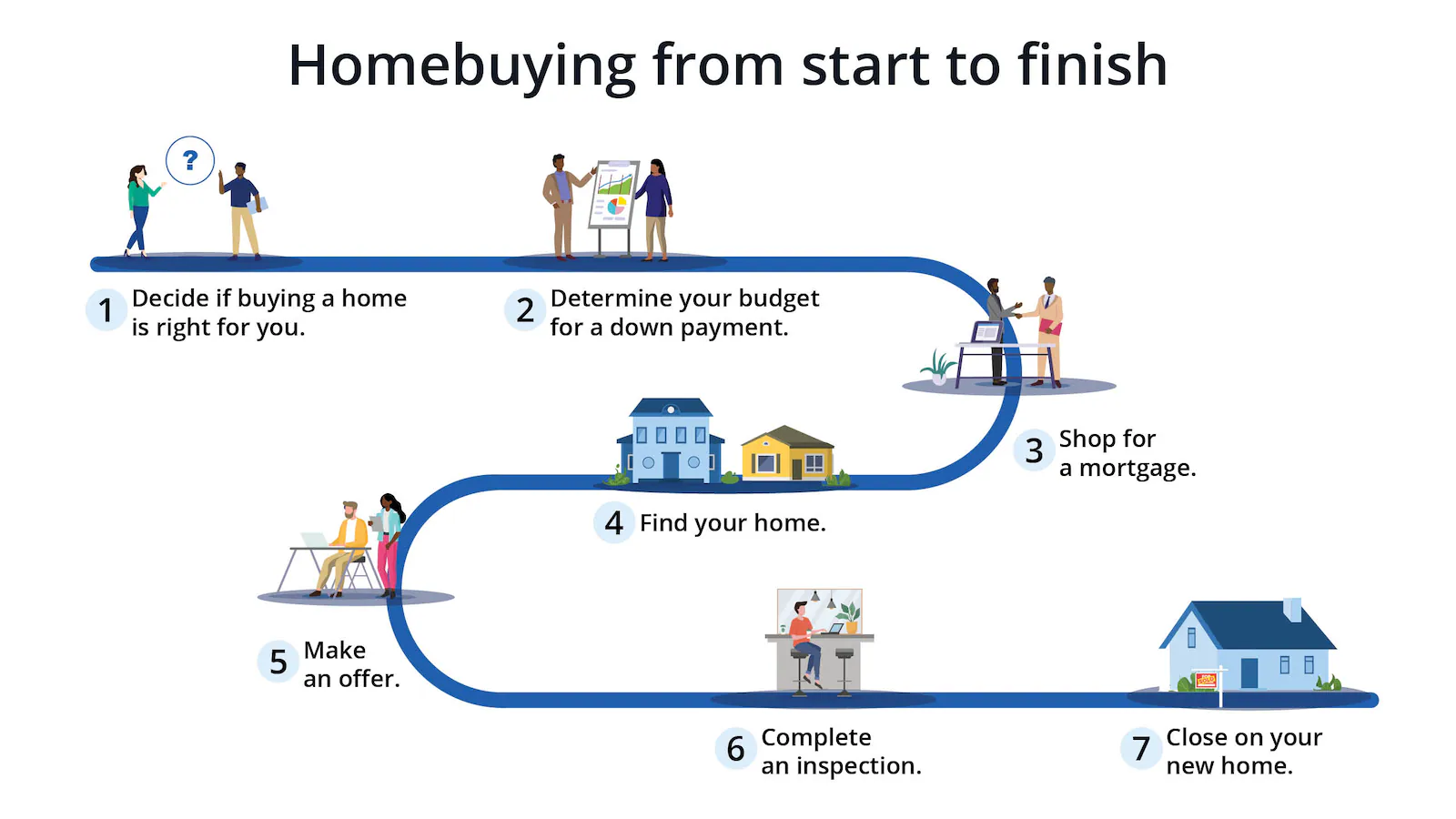
    Buying your first home in 2026 may feel overwhelming, but the process is easier when you know what to expect.

    Many first-time buyers think they need perfect credit, a huge down payment, or years of financial knowledge before they can buy a home. That is not always true.

    Most buyers succeed by preparing their finances early, understanding how mortgages work, and following a clear plan from start to finish.

    This guide explains each step of the homebuying process in plain English so you can move forward with more confidence and fewer surprises.

    If you are wondering how to buy your first home, the process becomes much easier when you break it into clear steps and prepare before you start house hunting.

    Start With Your Budget

    Before you look at homes, figure out how much you can realistically afford.

    A lender may approve you for a certain amount, but that does not mean you should spend that much. Your mortgage payment needs to fit your life, not stretch your budget to the limit.

    Take a close look at your income, monthly bills, savings goals, and other expenses. You should also think about future costs, such as home repairs, maintenance, and property taxes.

    Many lenders use a Debt-to-Income ratio, often called DTI. This compares your monthly debt payments to your monthly income. A lower DTI usually makes it easier to qualify for a mortgage.

    Starting with a budget helps you avoid falling in love with a home that is outside your comfort zone.

    Check Your Credit And Financial Health

    Your finances play a major role in the mortgage process.

    Lenders review your credit history, income, savings, employment, and existing debts when deciding whether to approve a loan. The stronger your financial profile, the more options you may have.

    Check your credit before applying. This gives you time to fix errors, pay down debt, or improve your credit score if needed.

    It is also smart to build an emergency fund. Owning a home comes with unexpected expenses, and having savings can make those situations easier to handle.

    A little preparation today can save a lot of stress later.

    Save For A Down Payment And Closing Costs

    Many first-time buyers believe they need 20% down to buy a home.

    That is one of the biggest myths in homeownership.

    Depending on the loan program, some buyers may qualify with as little as 3% to 5% down. Government-backed loan programs may offer additional options for eligible borrowers.

    However, the down payment is not the only cost you need to plan for.

    You may also need money for closing costs, inspections, moving expenses, and reserves after closing. These costs can add up quickly if you are not prepared.

    Knowing the full picture helps you create a more realistic savings goal.

    Get Pre-Approved Before House Hunting

    A mortgage pre-approval is one of the most important steps in the buying process.

    Pre-approval helps you understand how much you may be able to borrow. It also shows sellers that you are a serious buyer who has already started the financing process.

    To get pre-approved, lenders often ask for documents such as pay stubs, W-2s, tax returns, bank statements, and identification.

    Many buyers confuse pre-approval with pre-qualification.

    Pre-qualification is usually a basic estimate. Pre-approval involves a deeper review of your finances and carries more weight when you submit an offer.

    Getting pre-approved before you shop can save time and help you focus on homes within your budget.

    Compare Your Mortgage Options

    Not all mortgage loans work the same way.

    Different loan programs are designed for different types of borrowers. The best option depends on your credit profile, down payment, income, and long-term goals.

    Conventional loans are often used by buyers with strong credit and stable finances.

    FHA loans may offer more flexible qualification requirements for some borrowers.

    VA loans provide benefits for eligible veterans and military service members.

    USDA loans may help qualified buyers purchase homes in eligible rural areas.

    Instead of focusing only on interest rates, compare the total costs and features of each program before making a decision.

    Find A Home And Make An Offer

    Once you are pre-approved, you can start shopping for homes.

    A real estate agent can help you find properties, understand local market conditions, and negotiate with sellers.

    When you find a home you like, your agent can help prepare an offer based on current market conditions and comparable sales.

    Depending on the situation, negotiations may involve price, repairs, closing costs, or timelines.

    It can be tempting to stretch your budget when you find the perfect house. However, staying within your financial limits is usually the better long-term decision.

    Understand The Underwriting Process

    Underwriting is the lender’s final review before approving your loan.

    During this stage, the lender reviews your income, assets, debts, employment history, credit report, and information about the property.

    It is normal to receive requests for additional documents.

    Many buyers worry when they see underwriting conditions. In most cases, conditions simply mean the lender needs more information before moving forward.

    While your loan is being reviewed, try not to open new credit cards, buy a car, switch jobs, or make large bank deposits without talking to your lender first.

    Small financial changes can sometimes create delays.

    Prepare For Closing Day

    Closing is the final step before you become a homeowner.

    Before closing, you will usually complete a final walkthrough of the property. This gives you a chance to confirm that the home is in the expected condition.

    At closing, you will review and sign loan documents, pay any required closing costs, and complete the transfer of ownership.

    Once the paperwork is finalized and the loan funds, the home officially becomes yours.

    For many buyers, closing day feels like the end of the process.

    In reality, it is the beginning of your journey as a homeowner.

    Frequently Asked Questions

    How much money do I need to buy my first home?

    Many first-time buyers qualify with a down payment between 3% and 5%. You should also plan for closing costs, inspections, moving expenses, and emergency savings after you move in.

    What credit score do I need for a mortgage?

    Credit requirements vary by lender and loan program. Some programs have more flexible guidelines than others. Your overall financial profile is often just as important as your credit score.

    Is mortgage pre-approval required?

    Pre-approval is not legally required, but it is strongly recommended. It helps you understand your budget and can make your offer more attractive to sellers.

    How long does it take to get a mortgage?

    The timeline varies, but many home purchases take several weeks from application to closing. Delays often depend on documentation, underwriting, and market conditions.

    Should I choose an FHA loan or a Conventional loan?

    The right choice depends on your credit score, down payment, debt levels, and long-term goals. Compare the total costs and benefits of each option before deciding.

    Buying your first home in 2026 does not require perfect timing or perfect finances.

    The key is understanding the process before you begin. A strong budget, healthy savings, mortgage pre-approval, and realistic expectations can help you move through the process with confidence.

    The more prepared you are before making an offer, the smoother your path to homeownership will be.

    Learning how to buy your first home is less about perfect timing and more about understanding the process before you begin.

    Wonder Rates NMLS #1518655. Equal Housing Lender. This is not a commitment to lend. Rates and terms are subject to change without notice. Subject to credit approval. Information provided is for educational purposes only.

  • If the Fed Doesn’t Set Mortgage Rates, Why Does Everyone Obsess Over Every Fed Meeting?

    If the Fed Doesn’t Set Mortgage Rates, Why Does Everyone Obsess Over Every Fed Meeting?

    Most buyers know the basic story by now: the Federal Reserve does not directly set mortgage rates.

    Yet every Fed meeting still dominates mortgage headlines.

    Lenders talk about it. Financial media analyzes every word. Buyers wait for the announcement hoping rates will move in their favor.

    If the Fed Doesn’t Set Mortgage Rates, What Actually Does?

    The answer reveals a deeper truth about how mortgage markets actually work.

    The mistake many buyers make is treating mortgage rates as a Fed story.

    If you’re new to mortgage financing, start by understanding what a mortgage is and how home loans work. [What Is a Mortgage? How Home Loans Work for First-Time Buyers]

    In reality, mortgage rates are a bond market story.

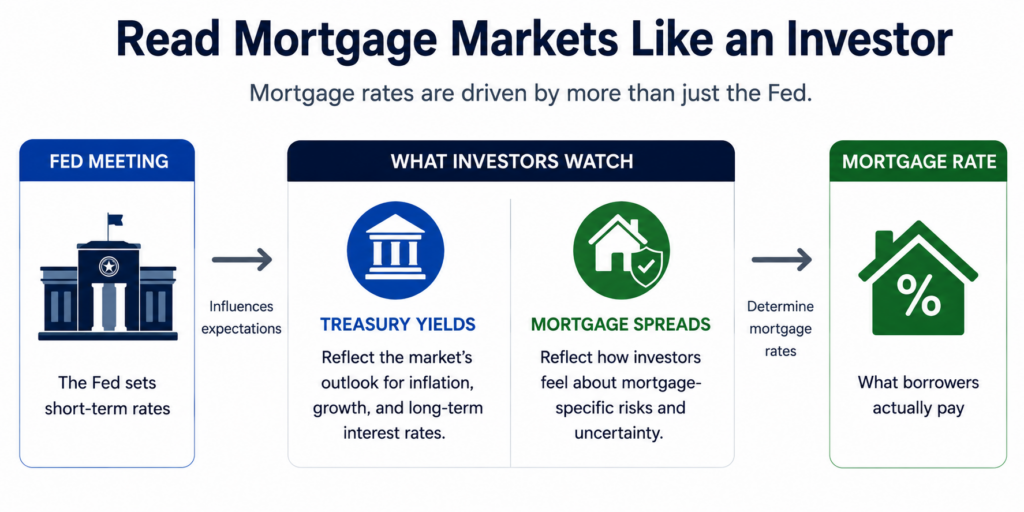
    The Fed matters, but not because it directly determines the rate on a 30-year mortgage. It matters because investors use Fed decisions to update their expectations about inflation, economic growth, and future risk. Those expectations influence the bond market, and the bond market is where mortgage rates are ultimately priced.

    Understanding that distinction can completely change how you interpret mortgage news.

    The Fed Controls One Rate. Mortgage Investors Care About Many Others.

    When investors buy mortgage-backed securities (MBS), they are committing capital for years, not days.

    As a result, they focus less on the Fed’s current target rate and more on the broader economic outlook. They want to understand where inflation is headed, whether economic growth is likely to slow, how refinancing activity may change, and how much risk they should be compensated for taking.

    Those long-term expectations have a much greater influence on mortgage pricing than the federal funds rate itself.

    That is why mortgage rates sometimes move before a Fed meeting, sometimes after it, and occasionally in the opposite direction many buyers expect.

    The market is not simply reacting to today’s rate decision. It is reacting to what that decision signals about the future.

    What Investors Are Really Listening for During a Fed Meeting

    federal-reserve

    Most buyers focus on the announcement itself. Bond investors, however, are often more interested in the message behind it.

    For example, imagine the Fed cuts rates by 0.25%. At first glance, that sounds positive for mortgage rates. But investors immediately ask a second question:

    Why did the Fed cut?

    If investors believe inflation is cooling and the economy is moving toward a stable landing, they may become more comfortable buying long-term bonds. Treasury yields may fall, mortgage spreads may tighten, and mortgage rates may decline.

    But if investors believe the Fed is cutting because economic conditions are deteriorating faster than expected, the reaction can be very different. Uncertainty rises. Volatility increases. Investors may demand more compensation for risk.

    Mortgage rates may not fall as much as expected.

    The same Fed decision can produce different mortgage outcomes because mortgage markets are pricing future expectations, not simply today’s announcement.

    That is why experienced market participants often pay more attention to the Fed’s projections, press conference, and economic outlook than to the rate change itself.

    Why Mortgage Rates Follow the 10-Year Treasury

    Most buyers eventually hear that mortgage rates tend to move with the 10-year Treasury yield.

    At first, that may seem counterintuitive. After all, a traditional mortgage can last up to 30 years, so why would investors compare it to a 10-year bond?

    The answer lies in how mortgages behave in the real world. Most borrowers do not keep the same mortgage for three decades. They move, refinance, or sell their homes long before the loan reaches maturity.

    As a result, investors often view mortgages as assets with an effective lifespan closer to seven to ten years. That makes the 10-year Treasury a useful benchmark for pricing mortgage debt.

    As of June 5, 2026, Freddie Mac’s Primary Mortgage Market Survey (PMMS) reported the average 30-year fixed-rate mortgage at 6.48%. During roughly the same period, the 10-year Treasury yield traded near 4.5%.

    While those figures move in the same general direction over time, they are rarely identical. Understanding what creates the gap between them is one of the most important concepts in mortgage pricing.

    The Metric Most Buyers Never Watch: Mortgage Spreads

    The difference between mortgage rates and Treasury yields is known as the spread.

    In simplified terms:

    Mortgage Rate − 10-Year Treasury Yield = Mortgage Spread

    Using the figures above:

    • Mortgage rate: 6.48%
    • Treasury yield: 4.50%

    Spread ≈ 1.98%

    Many buyers stop there.

    But the spread is more than a math exercise. It is one of the clearest windows into how investors feel about mortgage risk.

    A wider spread often means investors want additional compensation for uncertainty.

    That uncertainty may include:

    • Interest rate volatility
    • Refinancing behavior
    • Liquidity conditions
    • Demand for mortgage-backed securities

    In other words:

    A mortgage rate is not just the cost of money.

    It is also the price of uncertainty.

    This is why two periods with similar Treasury yields can produce very different mortgage rates.

    The missing variable is often the spread.

    A Framework for Reading Mortgage Markets Like an Investor

    Instead of asking whether the Fed raised or cut rates, try asking two different questions.

    Lens 1: What happened to Treasury yields?

    Treasury yields reflect the market’s outlook for inflation, growth, and long-term interest rates.

    Lens 2: What happened to mortgage spreads?

    Mortgage spreads reflect how investors feel about mortgage-specific risks and uncertainty.

    Together, these two lenses provide a more useful framework than Fed headlines alone.

    Treasury Yield Mortgage Spread Likely Mortgage Impact
    Down Down Strongly favorable
    Down Up Mixed outcome
    Up Down Mixed outcome
    Up Up Less favorable

    Consider a simple example.

    Assume:

    • 10-year Treasury = 4.50%
    • Mortgage spread = 2.00%

    Mortgage rate ≈ 6.50%

    Now assume the Treasury yield stays exactly the same, but investor confidence improves and the spread narrows to 1.50%.

    Mortgage rate becomes:

    4.50% + 1.50% = 6.00%

    Mortgage rates fall by approximately 0.50% even though the Fed did nothing and Treasury yields did not move.

    That is the kind of market dynamic many buyers miss when they focus exclusively on Fed meetings.

    Infographic showing how Fed meetings influence investor expectations, Treasury yields, mortgage spreads, and ultimately mortgage rates.

    The Better Way to Interpret Fed News

    Fed meetings deserve attention, but they should be viewed as signals rather than direct pricing events.

    While the Fed influences the broader economic outlook, mortgage rates are ultimately shaped by how investors interpret inflation, growth, and risk.

    That is why mortgage rates sometimes move with Fed decisions, sometimes ignore them, and sometimes appear to react in unexpected ways.

    The next time a Fed meeting dominates the headlines, look beyond the rate announcement itself. Watch Treasury yields. Watch mortgage spreads.

    Because the most important mortgage story is rarely what the Fed did. It is how the bond market interpreted what the Fed said.


    FAQs

    Does the Fed Directly Set Mortgage Rates?

    No. The Federal Reserve sets the federal funds rate, which influences short-term borrowing costs. Mortgage rates are primarily determined by bond markets, investor expectations, Treasury yields, and mortgage-backed securities. This is why mortgage rates can move independently of Fed rate decisions.

    Why Do Mortgage Rates Change After Fed Meetings?

    Mortgage rates often change after Fed meetings because investors reassess expectations for inflation, economic growth, and future interest rates. The market reaction to the Fed’s outlook can have a greater impact on mortgage rates than the actual rate decision itself.

    What Affects Mortgage Rates the Most?

    Several factors influence mortgage rates, including Treasury yields, inflation expectations, mortgage spreads, and investor demand for mortgage-backed securities. While Fed policy plays a role, long-term market expectations are often more important than a single Fed meeting.

    Why Do Mortgage Rates Follow the 10-Year Treasury?

    Mortgage rates tend to move with the 10-year Treasury yield because most mortgages are paid off, refinanced, or sold long before 30 years pass. As a result, investors often use the 10-year Treasury as a benchmark when pricing mortgage-backed securities.

    Should You Wait for a Fed Rate Cut Before Buying a Home?

    Not necessarily. A Fed rate cut does not guarantee lower mortgage rates. In some cases, mortgage rates may already reflect expected Fed actions before the announcement occurs. Buyers should evaluate affordability, market conditions, and personal financial readiness rather than relying solely on Fed meetings.


    Wonder Rates NMLS #1518655. Equal Housing Lender.

    For educational purposes only. Not a commitment to lend. Rates and terms subject to change. Mortgage rates and APRs vary by borrower profile, loan type, lender pricing, and market conditions. For information specific to your situation, consult a licensed Loan Officer.

  • Lock or Float? Here’s the Framework That Replaces the Guesswork

    Lock or Float? Here’s the Framework That Replaces the Guesswork

    Lock or float? Nobody can predict rates. But you can calculate the risk.

    Here’s a 4-input framework to decide.

    The lock-or-float choice isn’t a market prediction. It’s a risk calculation.

    Locking buys certainty: your lender locks a rate for a set window (commonly 30, 45, or 60 days). Floating keeps your options open. If rates drop before closing, you gain. If they rise, you end up paying more.

    The market doesn’t know your closing date or budget. This framework helps you weigh the variables that actually matter.

    Lock or Float: What Are You Actually Deciding?

    Most buyers ask: “Where are rates going?” That is the wrong question.

    The right one: “If I am wrong, what does it cost me?”

    A prediction asks you to be right. A risk calculation asks you to be prepared. The framework below helps you do the second one.

    The four inputs that actually matter

    1. Time to closing

    This is your first question. How many days stand between now and your closing date?

    A longer float window means more exposure to rate movements. The more time you spend unprotected by a rate lock, the more opportunities there are for rates to move against you. While the relationship is not perfectly linear, a longer timeline generally means greater uncertainty and a wider range of possible outcomes.

    A useful mental model: think of your time horizon in quarters. Under 30 days is one zone. Thirty to 45 is another. Over 45 days is a third, and it carries more uncertainty meaningfully.

    2. Your breakeven on a rate move

    Here is the concrete math. Say you are financing $450,000.

    A 0.25% rate increase on a 30-year mortgage typically adds about $17 per month for every $100,000 borrowed.

    Calculation:

    $17 × 4.5 = about $77 more per month

    Over 12 months:

    $77 × 12 = about $924 more per year

    If floating is free (some lenders charge a float-down fee; we’ll talk about that later), and you close in 45 days, your downside is about $804 each year. This continues for the life of that rate, starting now. Ask yourself: how much would rates need to fall for the monthly savings to feel worth carrying that risk?

    The math is symmetric. A 0.25% drop saves you the same $67/month. But the psychological experience is not symmetric. Research on financial decision-making shows that losses hurt more than gains. Losses hit harder. That asymmetry is worth naming because it will influence your gut reaction, whether you acknowledge it or not.

    3. Your actual risk tolerance, not the hypothetical one

    There is a difference between how you think you handle uncertainty and how you actually handle it at 11 p.m., watching mortgage news.

    A useful question: if rates rose 0.375% tomorrow and you had been floating, would you sleep fine? Or would you spend the next three weeks second-guessing the decision and checking rates daily?

    If the honest answer is the second one, that is not a weakness. It is a data point. Certainty has real value when you are already carrying the stress of a home purchase. The “cost” of locking is not just the rate itself. It also includes what you give up by closing the optionality. For some buyers, that optionality is worth very little because the mental overhead of monitoring it is too high.

    4. The float-down option, if your lender offers it

    Some lenders have a float-down provision. You lock in your rate today, but if rates drop by a set amount before closing, you can negotiate for the lower rate. This product costs something, either as a fee or baked into a slightly higher rate.

    Before assuming floating is your only way to capture a rate drop, ask whether a float-down is available. Run the math on the fee versus your probability-weighted downside exposure.

    Example: if a float-down costs 0.125% of the loan amount on a $450,000 loan, that is $562.50. If you believe there is a 30% chance that rates fall 0.25%, your expected monthly savings would be about $20/month. The float-down breaks even after roughly 28 months. Whether that is worth it depends on how long you plan to hold the loan.

    What moves rates in your lock window

    You do not need to become a bond trader. Knowing what drives rate changes in 30 to 60 days helps you tell if the environment is calm or volatile.

    Mortgage rates track closely with 10-year Treasury yields, which respond most sharply to:

    • Inflation data (CPI and PCE releases)
    • Federal Reserve meeting decisions and Chair statements
    • Job reports (strong employment tends to push rates up)
    • Major geopolitical or financial market disruptions

    If several of these events fall inside your lock window, you are floating through more market noise than if your window is quiet. Your loan officer can tell you what economic calendar events fall between now and your closing date. That’s a good question to ask. The answer should shape your thoughts.

    The framework as a decision map

    Put the four inputs together, and you get a way to think through your own situation:

    • Short window, low volatility calendar, high stress tolerance → the case for floating is more manageable
    • Long window, volatile calendar, limited budget buffer → the value of locking certainty increases
    • Somewhere between → that is where the float-down conversation becomes worth having

    None of these combinations tells you what to do. They tell you what you are trading. That is the point.

    A locked rate is not a loss if rates stay flat or rise. A floated rate is not a win if rates drop, but you spent six weeks anxious. The goal is a decision you can commit to with clear reasoning, not one you will revisit every morning until closing.

    One last thing to audit

    Before you finalize your thinking, confirm one number with your lender: the exact cost, if any, of extending your lock if closing gets delayed. Delays happen, and a rate lock extension can cost 0.125% to 0.375% of the loan depending on the lender and how long the extension runs. If your transaction has any complexity, factor that cost into the analysis before you assume a shorter lock is always cheaper.

    The lock-or-float decision is not a market call. It is a personal risk calculation with four inputs: your time to closing, your breakeven on a rate move, your honest stress tolerance, and the cost of any float-down option available to you. Run those four numbers against your situation, and the decision gets a lot clearer than checking the headlines.

    WonderRates NMLS #1518655 | Equal Housing Lender.

    This article is for educational purposes only and does not constitute financial or mortgage advice. Mortgage rates, loan terms, and lender policies vary and are subject to change. Consult a licensed loan officer to evaluate the options that fit your specific transaction and financial situation.

  • Why Underwriters Read Your Bank Statements Line By Line: Large Deposits, Seasoned Funds, And The Paper Trail

    Why Underwriters Read Your Bank Statements Line By Line: Large Deposits, Seasoned Funds, And The Paper Trail

    Most buyers think bank statements have one job: proving they have enough money for a down payment.

    That is only part of the story.

    When your loan file reaches an underwriter (the person who reviews and approves loan files), the focus often shifts from how much money you have to where that money came from.

    A borrower may have enough money to close and still receive extra questions because of a deposit made weeks earlier.

    NMLS# 1518655

    Why The Source Of Money Matters

    Lenders must make sure the money used for a home purchase is real, documented, and consistent with the loan file.

    The concern is usually not the account balance itself.

    The concern is whether a deposit came from a gift, a transfer, the sale of an asset, or a loan that has not been disclosed.

    For example, imagine a borrower receives $10,000 from a friend and plans to pay it back later.

    That repayment could affect the borrower’s Debt-to-Income (DTI) ratio, which compares monthly debt to monthly income.

    Without documents, the lender has no way to know what happened.

    That is why a paper trail matters.

    What Are Seasoned Funds?

    One common mortgage term is seasoned funds.

    Seasoned funds are money that has been in your account long enough that the lender usually does not need to ask where it came from.

    Most lenders review the two most recent monthly bank statements. Because of that, funds already in the account before that review period are often considered seasoned.

    A common guideline is about 60 days, although rules can vary by lender and loan program.

    For buyers planning to apply within the next few months, moving money shortly before applying may create extra questions.

    What Counts As A Large Deposit?

    A large deposit is a deposit that looks unusual compared with your income.

    For many Conventional loans, lenders may review deposits that are more than about 50% of your qualifying monthly income. FHA loans often use a similar approach.

    Simple Example

    Assumptions

    • Gross monthly income: $8,000
    • Review threshold: about $4,000

    If a non-payroll deposit of $5,000 appears in the account, the lender may ask where it came from and request supporting documents.

    The exact threshold can vary by lender, but the principle is the same: unusual deposits often need documentation.

    Why Cash On Hand Can Create Problems

    Many buyers keep some savings in cash and assume it will be treated the same as money already sitting in a bank account.

    The challenge is proof.

    Cash on hand does not create a clear record showing where the money came from or when it was saved.

    Because of that, cash on hand is generally not considered an acceptable source of funds under standard mortgage guidelines.

    A large cash deposit made shortly before applying can create additional questions instead of solving them.

    For buyers planning to purchase a home, keeping funds in documented accounts ahead of time is usually easier than explaining a large cash deposit later.

    A Simple Paper Trail Framework

    When a lender asks about a deposit, the goal is simple: connect the money to supporting documents.

    Think about it this way:

    Money In → Explanation → Proof

    Common examples include:

    • Gift funds → Gift letter + transfer records
    • Vehicle sale → Bill of sale + proof of deposit
    • Account transfer → Statements from both accounts

    The clearer the paper trail, the easier it is for the lender to verify the funds.

    Most Conditions Mean Something Is Missing

    Many buyers worry when they receive an underwriting condition.

    In many cases, a condition simply means more information is needed.

    An unexplained deposit, a missing statement, or an undocumented transfer can all lead to follow-up questions.

    A clear Letter of Explanation (LOE) and the right supporting documents often solve the issue faster than sending information one piece at a time.

    Three Questions To Ask Before Applying

    Before you submit a mortgage application, review your recent bank statements and ask yourself:

    1. Are there any large deposits that may need an explanation?
    2. Do I have documents for gifts, transfers, or asset sales?
    3. Are my down payment funds already seasoned?

    Answering these questions before underwriting begins may help reduce delays later.

    Bottom Line

    Most buyers focus on how much money is in their account.

    Underwriters focus on where that money came from.

    That is why bank statements are reviewed line by line.

    A strong file is not just a file with enough money. It is a file with a clear paper trail behind every important deposit.

    Understanding seasoned funds, large deposits, cash on hand, and documentation requirements can help you prepare before underwriting starts.

    If you would like to discuss documentation requirements for your situation, speak with a licensed Wonder Rates loan officer. No pressure, just clarity.

    DISCLAIMER: Wonder Rates NMLS# 1518655. Equal Housing Lender. This is not a commitment to lend. Rates and terms subject to change. Subject to credit approval. Information is for educational purposes only.

  • Before you add a family member to your mortgage, read this

    Before you add a family member to your mortgage, read this

    Your brother needs help qualifying for a mortgage. You say yes.

    Your brother needs help qualifying for a mortgage. You agree. Six months later, he misses two payments. Your credit score drops. You had no idea it was coming.

    This is not a worst-case scenario. This is one of the most common mistakes families make.

    The reason is simple: almost no one explains the difference between co-borrower and co-signer before signing.

    1. Co-borrower vs. Co-signer: The difference nobody explains

    Most people use these terms interchangeably. Lenders do not.

    You’re… Co-Borrower Co-Signer
    On the loan Yes Yes
    On the title Yes No
    Own the home Yes No
    Income counted for qualification Yes Yes
    Responsible for full debt if they don’t pay Yes Yes
    Credit affected by late payments Yes Yes
    Affects your DTI (debt-to-income ratio) Yes Yes
    Easy to remove later No No

    Co-borrower: on the loan and on the title. They own the home. Their income counts for qualification, but their debt counts too.

    Co-signer: on the loan, not on the title. They do not own the home. Their income helps qualify. They have no legal claim to the property.

    Same signature. Completely different position.

    2. What it means to be a co-borrower

    When you’re a co-borrower, you’re a co-owner.

    Your name is on the deed. You have legal rights to the property. But you also have full responsibility for the debt. Not half. Not a share. All of it.

    Here’s what that looks like in practice:

    • Your credit is tied to every payment. If the primary borrower pays late, your credit takes the hit. On time, every month, for the life of the loan.
    • Your debt-to-income ratio goes up immediately. Lenders count the full mortgage payment against your debt-to-income ratio. If you want to buy your own home later, that number follows you to your next application.
    • You can’t walk away quietly. Your name stays on the loan until it’s paid off or refinanced. There’s no form to fill out, no phone call to make. The only exit is a full refinance. The remaining borrower must qualify alone.

    3. What it means to be a co-signer

    Co-signer feels lower stakes. It’s not.

    You’re not in the title. You own nothing. But if the primary borrower stops paying, you must pay the full amount.

    The loan appears on your credit report. Every month. Whether payments are on time or not.

    You have no say in what happens to the home. The primary borrower can sell, rent, or let the property fall into disrepair. You have no legal standing to stop them.

    You cannot remove yourself from the loan. Like a co-borrower, the only way out is to refinance. This relies completely on the primary borrower’s ability to qualify alone.

    You took on all the financial risk. You own none of the assets.


    The risks nobody mentions before you sign

    1. Your own mortgage becomes harder to get

    The moment you co-sign or co-borrow, that monthly payment counts against your DTI.

    Many lenders still consider a 43% DTI a useful benchmark. However, the Consumer Financial Protection Bureau’s General QM final rule in 2021 lifted the strict 43% limit. Now they also consider APR vs. APOR, and may use Fannie Mae, Freddie Mac, or FHA underwriting standards.

    If you’re close to that threshold, one co-signed loan can push you over. What looks like a favor today can delay your own purchase by years.

    2. A missed payment hits you without warning

    Under the Federal Trade Commission rule, creditors must provide a “notice to cosigner” before signing. But co-signers are not always entitled to monthly billing statements.

    You may find out about a missed payment after your score has already dropped.

    Not before.

    3. Disagreements have no easy exit

    The National Association of Realtors (NAR) says that most failed real estate deals are because of disputes. These often involve inspections and repairs.

    What if one co-borrower wants to sell and the other doesn’t? What if one stops contributing to the mortgage? These situations require legal intervention. Not a conversation at the dinner table.

    4. Life changes the plan

    Job loss, divorce, relocation. What seems stable today can look very different in three years. The loan does not care about changed circumstances.

    5. First-time buyers face real down payment hurdles

    NAR 2022 found that 26% of first-time buyers said saving for a down payment was the hardest part. For many families, this barrier is even higher.

    When things go wrong: How do you get out

    This is the question most people ask too late.

    • If you’re a co-borrower: The primary borrower must refinance the loan in their name only. They must qualify based on their own income, credit, and DTI without you. If they can’t qualify, you stay on the loan.
    • If you’re a co-signer: Same answer. Refinance is the only clean exit. You can’t call the lender and ask to be removed.

    What about a quitclaim deed?

    A quitclaim deed removes your name from the title. It does not remove you from the loan. You can sign away ownership and still be responsible for the debt.

    This surprises almost everyone who learns it.

    There is no shortcut. Plan your exit before you enter.

    Tenancy in Common vs Joint Tenancy: The Title Question Most People Skip

    If you move forward as co-borrowers, how you hold title matters.

    Ownership Type What Happens When One Owner Dies
    Joint Tenancy Share automatically transfers to surviving owner. No probate, no waiting. Right of survivorship applies.
    Tenancy in Common Each owner holds a separate share. Share goes to their estate  distributed according to their will or state law. Surviving co-owner does not automatically inherit.

    Many siblings pick joint tenancy. They often don’t think about how it affects their heirs. Talk to a real estate attorney before you decide.

    Lower down payment options exist. You don’t need 20%

    Many people think they need 20% down to buy a home. You don’t:

    Loan Program Minimum Down Payment Minimum Credit Score
    FHA Loan 3.5% 580+
    Fannie Mae HomeReady 3% Typically 620+
    VA Loan 0% Varies by lender
    USDA Loan 0% Varies by lender

    Government-backed loans offer lower barriers:

    • According to HUD, FHA loans require only 3.5% down.
    • HomeReady from Fannie Mae allows 3% down for first-time buyers.
    • VA and USDA loans require 0% down for eligible borrowers.

    Before you say yes: Eight-question checklist

    Use this before agreeing to co-borrow or co-sign for anyone.

    1. Do you understand the difference between co-borrower and co-signer?
    2. Have you calculated how this affects your own DTI?
    3. Do you have a plan if the primary borrower misses payments?
    4. Have you talked through what happens if one party wants to sell?
    5. Do you know what it takes to remove your name from the loan later?
    6. Have you decided how you will hold title joint tenancy or tenancy in common?
    7. Are you comfortable with this commitment for the full loan term?
    8. Have you received the FTC “Notice to Cosigner” (if co-signing)?

    If you cannot answer yes to all 8, you are not ready to sign.

    Frequently asked questions

    Can a co-signer be removed from a mortgage?

    Only through refinance. The primary borrower must qualify for the loan on their own. There is no other path.

    Does co-signing affect my ability to get my own mortgage?

    Yes. The loan appears on your credit report and counts toward your DTI. Lenders will factor it in when you apply for your own home loan.

    What’s the difference between a co-borrower and a joint borrower?

    They are the same thing. Both terms refer to someone who is on the loan and on the title.

    Can a co-borrower be removed from the title but stay on the loan?

    Yes, through a quitclaim deed. But this only affects ownership, not financial responsibility. You can give up ownership rights and still owe the debt.

    What happens to the mortgage if a co-borrower dies?

    The surviving co-borrower becomes fully responsible for the loan. How ownership transfers depends on your title type. Were you joint tenants? Or tenants in common? Consult a real estate attorney before making that decision.

    Does the lender have to notify a co-signer about missed payments?

    Not always. Creditors must give a “Notice to Cosigner.” This is required by the FTC Credit Practices Rule. However, the rights for late payment notifications differ by state. Do not assume you will be warned before a late payment hits your credit report.

    Helping a family member buy a home is a generous thing to do.

    But co-borrowing and co-signing are financial commitments. Not favors. Your credit. Your DTI. Your future purchasing power. All on the line. The loan does not know you did this out of love.

    Understand exactly what you’re agreeing to. Ask the hard questions before you sign.

    And if anything in this guide gave you pause, that pause is worth listening to.

    Thinking about buying a home with a family member or co-signing for someone you love?

    Talk to a licensed loan officer first. Understanding your options takes 30 minutes. Undoing the wrong decision can take years.

    This article is for educational purposes only and is not a commitment to lend. Loan approval is subject to qualification and program guidelines. Interest rates and terms are subject to change without notice. Co-borrower and co-signer arrangements involve legal and financial obligations that vary by state. Talk to a licensed mortgage expert and a qualified legal advisor for advice that fits your needs. FTC Credit Practices Rule disclosures apply to co-signer transactions. CFPB regulations apply to all mortgage loan transactions.

    WonderRates | NMLS #1518655 | Equal Housing Lender

  • The Truth About Loan Officers: They’re Not Salespeople.

    The Truth About Loan Officers: They’re Not Salespeople.

    Loan officers are often mistaken for salespeople. It is an easy assumption to make when the first thing you hear is a rate quote. But that view misses most of what actually determines whether your loan gets approved or falls apart.

    1. The Reality Behind the “Rate Quote”

    You ask about rates, and your loan officer says something like: “Based on your profile, rates today are around 6.5%, but I cannot promise that until we lock it in writing, since things change daily.”

    That can sound unclear. It is not.

    Under federal rules, a loan officer cannot present a rate like a fixed price tag. Rates move daily with the market, and your final number depends on your full file, the appraisal, and when you lock. A good loan officer is not selling certainty. They are managing your expectations within the law.

    2. Who a Loan Officer Is and Is Not

    A loan officer, officially called a Mortgage Loan Originator, is your bridge to the lender. They guide you from your first question all the way to closing day, translating your financial life into something a lender can evaluate.

    But they are not the decision-makers. They are not the underwriter who approves or denies your loan, and they are not the appraiser who determines the home’s value. They are also not your real estate agent. Their role is narrower and more technical.

    Their job is simple to describe, but hard to execute: build a file that gets approved.

    3. Perception vs. Reality

    Loan officer infographic illustrating the difference between visible tasks and behind-the-scenes mortgage approval work.

    From the outside, the job looks simple. A few emails, some calls, maybe a couple of rate quotes.

    That is about 20% of it.

    The other 80% happens where you never see it. Your loan officer spends hours fixing documentation issues, aligning your file with federal guidelines, and keeping the deal alive as conditions change. If the loan does not close, they usually do not get paid, which means weeks of work can end with nothing.

    4. Income Reality: How They Actually Get Paid

    Loan officers are typically paid in basis points, not by interest rate. One hundred basis points equals 1% of the loan amount.

    For example, on a $400,000 loan, 100 BPS equals $4,000, while 50 BPS equals $2,000. Per industry survey, many retail loan officers earn roughly 90 to 105 BPS per funded loan, depending on experience and volume.

    Here is the key detail that most buyers miss.

    They are not paid more for giving you a higher rate.

    Under Regulation Z, compensation cannot be tied to loan terms like the interest rate. It can be tied to the loan amount or overall production. This rule exists to prevent steering you into a worse deal for higher pay.

    5. What Loan Officers Actually Do

    The work usually breaks into two layers.

    The first is what you see. This is the advisory side, where they compare loan options like Conventional, FHA, or VA based on your profile. They calculate your full monthly payment using PITI, including principal, interest, taxes, and insurance. They also move you from a rough estimate to a verified pre-approval, which strengthens your offer. If you’re buying a home for the first time, understanding where pre-approval fits into the home buying process can help you avoid delays later.

    The second layer is where most of the real work happens. They analyze your income, especially if it is variable or self-employed, and track key ratios like DTI and LTV to keep your file within approval limits. They respond to underwriter conditions, which often require updated documents like bank statements, pay stubs, or tax returns.

    A file can look strong at first glance and still fail if these details are not handled correctly.

    6. Constraints and Pressure

    Loan officers operate under strict regulatory timelines and rules. Under TRID guidelines, they must provide a Loan Estimate within three business days after your application. They cannot promise rates verbally, and they cannot guide you into a loan that benefits them more than you.

    They also cannot receive compensation from both you and the lender on the same transaction. Every step is monitored to protect you as a consumer, which adds pressure behind the scenes that most borrowers never notice.

    7. A Day in the Life

    To understand the role, it helps to look at a typical day.

    The morning often starts with checking rate sheets and pipeline updates. By mid-morning, they are calling clients and collecting missing documents. Late morning is spent running pre-approvals and calculating ratios, followed by coordinating with referral partners in the early afternoon.

    The rest of the day is usually consumed by handling underwriter conditions and coordinating closing details with title and escrow.

    Most of the day is not selling. It is problem-solving.

    8. Key Insight

    Approval is not luck. It is structure.

    A loan gets approved because hundreds of small requirements are met at the same time, from income documentation to timing rules. When your process feels smooth, it usually means problems were solved before you ever saw them.

    9. How to Verify Your Loan Officer

    Every licensed loan officer in the United States has an NMLS ID, and you can verify it in less than a minute.

    Go to https://nmlsconsumeraccess.org and search their name or NMLS number.

    Check three things:

    • The license status is active
    • They are authorized to operate in your state
    • There are no serious disciplinary actions

    If anything looks unclear, ask questions before moving forward.

    10. Conclusion

    Infographic comparing a salesperson and a loan officer, highlighting the broader responsibilities involved in guiding a mortgage loan to approval and closing.

    A loan officer is not just a salesperson. They are part analyst, part project manager, and part compliance guard.

    The rate may get your attention, but the real value is invisible. It shows up in how your file is structured, how problems are solved, and how regulations are navigated to get you to closing.

    That is what gets you the keys.

    FAQs

    Do loan officers set mortgage interest rates?

    No. Mortgage rates are influenced by the market and your financial profile. A loan officer can quote an estimated rate based on current conditions, but the final rate is only confirmed when it is locked in writing with the lender.

    Do loan officers earn more if you get a higher rate?

    No. Under federal law, loan officer compensation cannot be tied to the interest rate or loan terms. They are typically paid based on the loan amount or overall production, not the rate you receive.

    What does a loan officer actually do behind the scenes?

    Most of their work involves reviewing documents, calculating ratios, responding to underwriter conditions, and making sure your file meets lending guidelines. This behind-the-scenes work is what keeps your loan on track to close.

    How can you verify a loan officer is legitimate?

    You can check their NMLS ID on the official NMLS Consumer Access website. This lets you confirm their license status, the states they are authorized in, and whether they have any disciplinary history.

    Is a loan officer the same as a mortgage broker?

    Not always. A loan officer typically works for a specific lender, while a mortgage broker may work with multiple lenders. However, both must follow the same federal rules regarding disclosure, compensation, and consumer protection.


    Wonder Rates NMLS # 1518655

    Equal Housing Lender

    Disclaimer: This information is for educational purposes only and is not a commitment to lend.

  • What Is a Mortgage? How Home Loans Work for First-Time Buyers

    What Is a Mortgage? How Home Loans Work for First-Time Buyers

    What is a mortgage? Many first-time homebuyers ask this question when they begin exploring financing options.

    Buying a home feels exciting until the financing part starts sounding confusing.

    You hear terms like interest rate, escrow, PMI, or DTI, and suddenly you’re not sure what you’re agreeing to. Most first-time buyers reach this point.

    The good news is that mortgages are easier to understand once you break them into smaller pieces. This guide explains how mortgages work, what makes up your monthly payment, and what lenders look for when reviewing your application.

    If you’re planning to buy a home soon, it also helps to understand the overall home buying process before applying for a mortgage.


    What Is a Mortgage and How Does It Work?

    A mortgage is a loan used to purchase a home. You borrow money from a lender and agree to repay it over time, usually with interest.

    The property serves as collateral for the loan. If payments stop for an extended period, the lender may have the legal right to take ownership of the property through foreclosure.

    Most mortgages have repayment terms of 15 or 30 years.

    A 15-year mortgage typically comes with higher monthly payments but lower total interest costs. A 30-year mortgage spreads payments over a longer period, reducing monthly payments while increasing the total interest paid over the life of the loan.

    For example, borrowing $320,000 at a 6.5% interest rate on a 30-year mortgage produces a lower monthly payment than a 15-year mortgage, but the overall interest expense is significantly higher.

    Once the loan is paid in full, the lender’s claim on the property is removed, and you own the home free and clear.


    What Is Included in a Mortgage Payment? (PITI)

    Your monthly mortgage payment is commonly referred to as PITI, which stands for:

    The four PITI components of a mortgage home loan: Principal, Interest, Taxes, and Insurance.

    Principal

    The portion of your payment that reduces your loan balance.

    Interest

    The cost of borrowing money from the lender.

    For example, a $320,000 mortgage at 6.5% generates a principal and interest payment of approximately $2,020 per month.

    Taxes

    Property taxes are often divided into monthly installments and collected with your mortgage payment.

    Insurance

    Homeowners insurance protects the property and is typically required by lenders.

    Example Mortgage Payment

    Home Price: $400,000

    Down Payment: 20%

    Loan Amount: $320,000

    Estimated Monthly Payment

    • Principal & Interest: $2,020
    • Property Taxes: $367
    • Homeowners Insurance: $125

    Total Estimated Payment: $2,512 per month


    Additional Costs in a Mortgage Payment

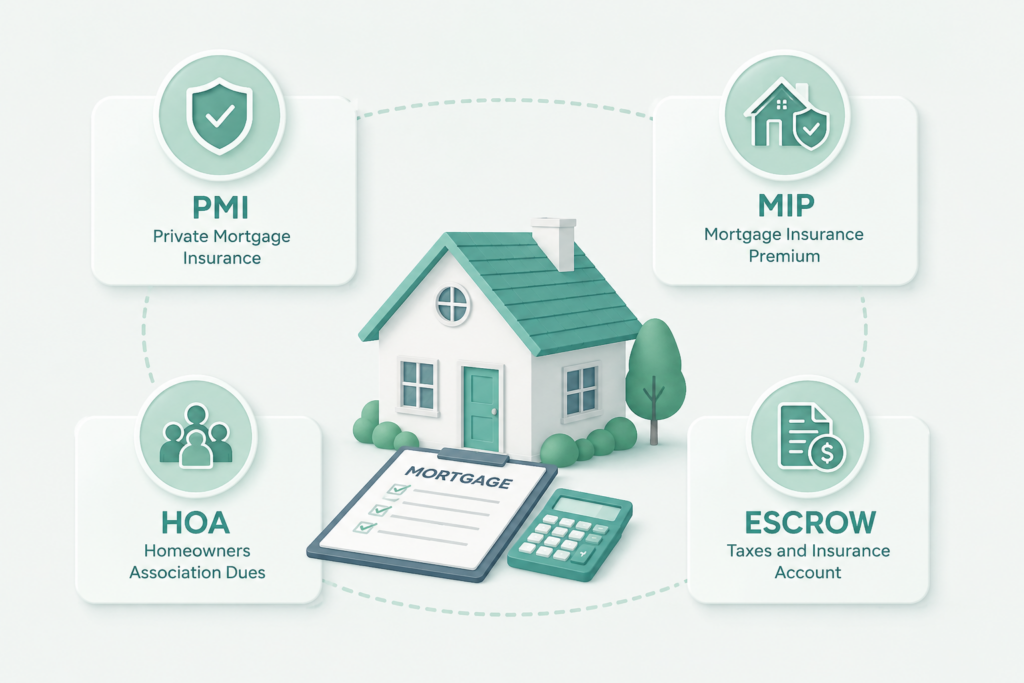
    Depending on your loan type and financial situation, additional expenses may be included in your monthly payment.

    Illustration of additional mortgage costs including PMI, MIP, HOA fees, and escrow accounts.

    PMI (Private Mortgage Insurance)

    PMI applies to many conventional loans when the down payment is less than 20%.

    It protects the lender, not the borrower.

    In many cases, PMI can be removed once the loan-to-value ratio reaches 80%.

    MIP (Mortgage Insurance Premium)

    MIP applies to FHA loans.

    Unlike PMI, MIP often remains for the life of the loan unless the borrower refinances into another mortgage program.

    HOA Dues

    Some properties located in planned communities or condominiums require monthly homeowners association fees.

    Escrow Account

    Many lenders collect money for taxes and insurance through an escrow account and pay those bills on your behalf when they become due.


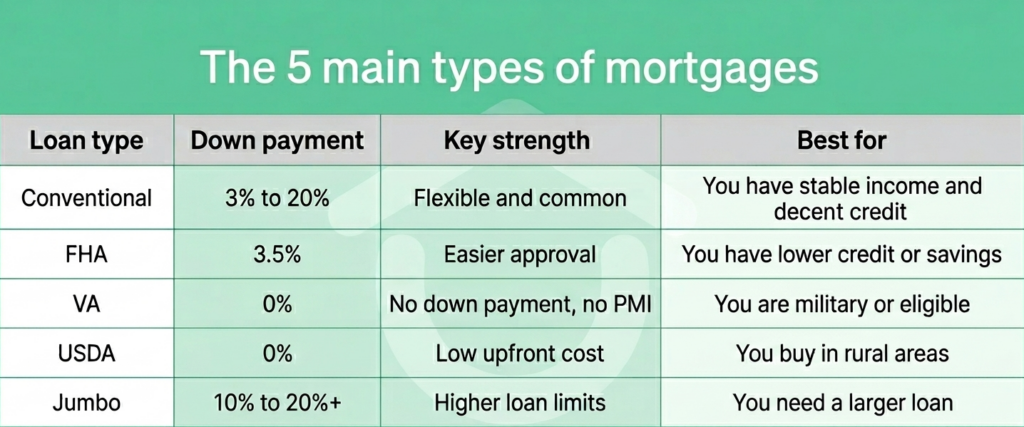
    The 5 main types of mortgages

    Mortgage loan type guide comparing down payments and benefits of Conventional, FHA, VA, USDA, and Jumbo loans for first-time buyers.

    Each mortgage program serves a different purpose.

    For example, FHA loans may be easier to qualify for, while VA loans provide significant benefits for eligible service members and veterans.


    Fixed-Rate vs Adjustable-Rate Mortgages

    A fixed-rate mortgage keeps the same interest rate throughout the loan term.

    This means your principal and interest payment remains predictable.

    An adjustable-rate mortgage (ARM) begins with a fixed rate for a specific period and then adjusts periodically based on market conditions.

    For example, a 5/1 ARM maintains the same rate for five years before adjusting annually.

    Fixed-rate mortgages offer stability, while ARMs may provide lower initial rates in exchange for future uncertainty.


    Why Early Mortgage Payments Go Mostly to Interest

    Many first-time buyers are surprised to learn that early mortgage payments contain more interest than principal.

    This happens because interest is calculated based on the remaining loan balance.

    At the beginning of the loan, the balance is at its highest point, so more of each payment goes toward interest.

    As the balance gradually decreases, a larger portion of your payment goes toward reducing principal.

    This repayment structure is known as amortization.


    How to Qualify for a Mortgage

    Understanding how mortgages work is only the first step.

    Lenders also evaluate whether you are likely to repay the loan successfully.

    Credit Score

    Higher credit scores generally improve approval odds and may help borrowers qualify for lower interest rates.

    Debt-to-Income Ratio (DTI)

    DTI compares your monthly debt obligations to your monthly income.

    Lower ratios are typically viewed more favorably by lenders.

    Down Payment

    A larger down payment reduces risk and lowers the amount borrowed.

    Loan-to-Value Ratio (LTV)

    LTV measures the loan amount compared to the home’s value.

    Lower LTV ratios generally indicate lower risk.

    Common Documents Required

    • Proof of income
    • Tax returns
    • Bank statements
    • Government-issued identification

    Mortgage Pre-Qualification vs Pre-Approval

    Pre-qualification provides a basic estimate based on information supplied by the borrower.

    Pre-approval involves documentation review and a credit check.

    Because pre-approval verifies financial information, it generally carries more weight with sellers.

    In competitive housing markets, a pre-approval letter can strengthen your offer and improve your chances of securing a home.


    Mortgage FAQs

    What is a mortgage in simple terms?

    A mortgage is a loan used to purchase a home and repay it over time through monthly payments.

    Is a mortgage the same as a home loan?

    In most cases, the terms “mortgage” and “home loan” are used interchangeably.

    How much mortgage can I afford?

    The amount depends on your income, debts, credit score, down payment, and other financial factors.

    What credit score do I need for a mortgage?

    Requirements vary by lender and loan program, but many conventional mortgages prefer scores of 620 or higher. The Consumer Financial Protection Bureau provides additional resources to help first-time buyers understand mortgage requirements and prepare for the application process.


    Bottom Line

    A mortgage allows you to buy a home now and pay for it over time through structured monthly payments.

    Once you understand how mortgages work, comparing loan options, monthly costs, and qualification requirements becomes much easier.

    For many first-time buyers, the best next step is reviewing their credit profile and obtaining a mortgage pre-approval before beginning their home search. Understanding the role of a loan officer can also help you navigate the mortgage process more confidently.


    Ready to Take the First Step?

    Talk to a licensed loan officer and review your real numbers. Even a short conversation can help you understand what you can realistically afford and which mortgage options may fit your goals.


    Disclaimer

    Wonder Rates NMLS #1518655. Equal Housing Lender. This content is for informational purposes only and does not constitute financial, legal, or tax advice. Mortgage products, interest rates, and underwriting guidelines vary by lender and are subject to change without notice. This is not a commitment to lend. All loan applications are subject to credit and property approval.

  • The 10 Steps to Buying a Home in the US

    The 10 Steps to Buying a Home in the US

    Most buyers know they need a mortgage, but few understand what really happens between getting pre-approved and receiving the keys. Follow Wonder Rates to explore the 10 essential steps every homebuyer should know before closing.

    NMLS #1518655

    What Is the Homebuying Process? The 10 Steps to Buying a Home in the US

    The homebuying process is the series of steps that takes you from deciding to purchase a home to receiving the keys on closing day. While every transaction is unique, most buyers follow the same general path. Along the way, you’ll work with real estate agents, mortgage professionals, appraisers, inspectors, and title companies. Knowing what happens at each stage can help you stay organized and reduce stress throughout the journey.

    buying-a-home-in-the-us.
    What Is the Homebuying Process?

    How Long Does It Take to Buying a Home in the US?

    In the US, the homebuying process usually takes about 30–45 days from the time your offer is accepted until closing and you get the keys.

    But in real life, it can take longer depending on how fast you prepare and find a home. The process is usually split into 2 main phases:

    buying-a-home-in-the-us.webp2
    How Long Does It Take to Buying a Home in the US?

    1. Before making an offer (flexible time)

    This is the preparation stage:

    • You set your budget to see what you can really afford (not just the home price, but also taxes and insurance)
    • You get pre-approved by a lender to show you are qualified to buy
    • You start house hunting, visit homes, and pick the one you like

    2. After your offer is accepted (30–45 days)

    Once the seller accepts your offer, the home goes “under contract” and things move faster:

    • You put down earnest money into an escrow account
    • You do a home inspection to check the condition of the house
    • The lender does an appraisal to check the home’s value
    • Then comes underwriting, where the bank reviews your full loan file
    • Finally, closing: you sign the final papers, the loan is funded, and you get the keys

    What can slow things down?

    A few common delays include:

    • The home appraises lower than the purchase price
    • The bank asks for more documents
    • Paperwork processing takes longer than expected

    The 10 Steps to Buying a Home in the US

    Buying a home may seem complicated, but most transactions follow a predictable process. From determining your budget to signing the final paperwork, each step plays an important role in helping you become a homeowner. Here’s a quick overview of the 10 key steps you’ll typically go through when buying a home in the United States.

    buying-a-home-in-the-us
    The 10 Steps to Buying a Home in the US
    Step What Happens
    1. Determine Your Budget Review your income, savings, debts, and monthly expenses to understand how much home you can comfortably afford.
    2. Get Pre-Approved for a Mortgage A lender reviews your financial information and provides a pre-approval letter showing how much you may be eligible to borrow.
    3. Choose a Real Estate Agent An experienced agent helps you find homes, negotiate offers, and navigate the buying process.
    4. Start House Hunting Search for properties that fit your budget, preferred location, and lifestyle needs.
    5. Submit an Offer Work with your agent to prepare and submit a purchase offer to the seller.
    6. Open Escrow and Deposit Earnest Money Once your offer is accepted, you’ll deposit earnest money and open escrow to begin the transaction.
    7. Complete the Home Inspection A licensed inspector evaluates the property’s condition and identifies potential concerns.
    8. Complete the Appraisal The lender orders an appraisal to confirm the home’s market value.
    9. Go Through Underwriting The lender reviews your finances, documents, and property information before issuing final approval.
    10. Receive Clear to Close and Attend Closing Sign final documents, complete funding, and officially become a homeowner.

    Common Mistakes Homebuyers Should Avoid

    Even when people understand the overall homebuying process, a few common mistakes can create confusion, delays, or unexpected costs. Here are some of the most important ones to watch for:

    Forgetting Property Taxes and Insurance

    • Many buyers calculate affordability using only principal and interest.
    • Always use PITI (Principal, Interest, Taxes, and Insurance) to estimate your true monthly housing cost.

    Confusing Earnest Money with the Down Payment

    • Earnest money is a good-faith deposit submitted after an offer is accepted.
    • The down payment is the larger amount applied toward the home’s purchase price at closing.

    Mixing Up PMI and MIP

    • PMI applies to conventional loans with less than 20% down.
    • MIP applies to FHA loans.
    • These mortgage insurance programs are not interchangeable.

    Getting Inspection and Appraisal Out of Order

    • The buyer typically orders the home inspection first to identify property issues.
    • The lender then orders the appraisal to determine the home’s market value.

    Overlooking the Title Search

    • A title search helps uncover ownership disputes, liens, or legal claims against the property.
    • Skipping this step can lead to serious legal and financial problems.

    Misunderstanding Closing Documents

    • The buyer signs the Note and Mortgage documents.
    • The seller signs the Deed, which officially transfers ownership of the property.

    How to Take Action

    Start by reviewing your finances and understanding how much home you can realistically afford. Before you begin house hunting, obtain a mortgage pre-approval so you know your budget and can make stronger offers when you find the right property.

    It’s also important to work with trusted professionals throughout the process, including a knowledgeable real estate agent and a licensed loan officer. If you’re looking for guidance on mortgage options, loan requirements, and the homebuying process, consider partnering with a reputable mortgage company such as Wonder Rates. Having the right team by your side can help you navigate each step with confidence, avoid costly mistakes, and stay on track toward closing day.

    Keep your financial documents organized, respond quickly to lender requests, and don’t hesitate to ask questions along the way. Taking these steps early can make your homebuying journey smoother, faster, and less stressful.

    Bottom Line

    Buying a home involves multiple steps, but understanding the process can make it much less intimidating. By preparing early and working with the right professionals, you can move from house hunting to homeownership with confidence.

    Want help choosing the right loan? Talk to one of our licensed loan officers at ……

    Disclaimer: Wonder Rates NMLS #1518655 Equal Housing Lender. Information is provided for educational purposes only and is not a commitment to lend. Loan approval, rates, and terms are subject to lender review and applicable underwriting requirements.

  • Your Rate Lock Is a Clock. Here Is What Happens When It Runs Out

    Your Rate Lock Is a Clock. Here Is What Happens When It Runs Out

    Rate lock expiration is something many homebuyers never think about until closing gets delayed.

    Most people think a rate lock works like a receipt. You lock the rate, the rate is yours, and the story is over.

    The part most explainers skip is that a rate lock has an expiration date. If closing gets delayed, that date suddenly matters.

    Why Closing Delays Matter More Than Most Buyers Expect

    A 30-day lock often sounds like plenty of time.

    In reality, your closing timeline depends on several moving parts. An appraisal can come back late. A title issue can take longer than expected to resolve. Underwriting may request additional documentation. New construction timelines can shift.

    None of these automatically creates a problem. The challenge is that a shorter lock leaves less room for unexpected delays.

    That does not mean a 30-day lock is wrong. It means timeline risk is part of the decision.

    Rate Lock Expiration: What Happens When a Lock Expires?

    If your lock expires before closing, one of two things usually happens.

    The first possibility is a lock extension. Your lender agrees to extend the lock period, usually for a fee.

    Extension pricing is not standardized. Costs vary by lender, market conditions, loan type, and extension length. A commonly cited range is approximately 0.125 to 0.25 discount points per extension period, or roughly 0.02% to 0.05% of the loan amount per day, though actual pricing can differ significantly.

    All fee examples in this article are illustrative. Confirm current lock and extension pricing with your Loan Officer.

    The second possibility is that the loan must be repriced using current market conditions. If rates increased during the delay, the new pricing may be less favorable than the original lock.

    Two Buyers, Two Different Risks

    Imagine two buyers purchasing similar homes.

    One pays more upfront for a longer lock. The other chooses a shorter lock with lower upfront cost.

    Neither choice is automatically right or wrong. One buys additional time, while the other accepts more timeline risk.

    A Simple Cost Comparison

    Illustrative example only. Actual pricing varies based on credit profile, LTV, lender guidelines, and market conditions.

    Assumptions

    • Loan amount: $400,000
    • Loan term: 30-year fixed
    • Reference rate: 6.48% from Freddie Mac’s Primary Mortgage Market Survey (PMMS), week ending June 4, 2026
    • Lock options: 30 days, 45 days, and 60 days
    • Illustrative pricing: 30-day lock included in standard pricing, 45-day lock adds approximately 0.125 point, 60-day lock adds approximately 0.25 point.

    The 6.48% figure is a note rate from Freddie Mac PMMS for the week ending June 4, 2026. APR differs because it includes certain fees and financing costs and will be disclosed in your Loan Estimate.

    Lock Period Illustrative Cost
    30 days $0
    45 days ~$500
    60 days ~$1,000

    Now compare that with a delayed closing.

    If a 30-day lock requires an extension, the extension cost alone could fall within a range similar to the additional upfront cost of selecting a longer lock from the outset.

    There is also rate risk. Using the same $400,000 loan example, an increase of 0.25% in the interest rate would raise the principal-and-interest payment by roughly $66 per month. Over five years, that difference adds up to nearly $4,000.

    What this means for you: the important question is not simply, “How much does a longer lock cost?” A more useful question is, “What could it cost if my timeline runs longer than expected?”

    Who Pays the Extension Fee?

    The answer depends on the reason for the delay.

    If closing is delayed because documents arrive late, financial information changes, or additional borrower conditions must be satisfied, the borrower often bears the extension cost.

    If the delay comes from lender-side processing issues or operational errors, the lender may choose to absorb some or all of the expense. Policies vary, and there is no universal rule.

    A Framework for Thinking About Lock Length

    Rather than asking whether a 30-day, 45-day, or 60-day lock is “better,” consider two questions.

    1. How much timeline uncertainty exists?

    A straightforward purchase with clean documentation may have relatively little uncertainty. A new construction property, a complex income profile, or unresolved title issues may create more.

    2. What is the cost of being wrong?

    Compare the additional upfront cost of a longer lock with the potential cost of an extension and the possibility of less favorable pricing if the lock expires.

    It helps you understand the trade-off.

    Three Questions Worth Asking Before You Lock

    1. What are the current extension fees for my loan amount and lock period?
    2. What delays are most common for transactions like mine?
    3. If a delay occurs on the lender’s side, how are extension costs typically handled?

    Your Loan Officer can help you compare the costs and trade-offs using your actual timeline and loan scenario.

    A rate lock sets a deadline as much as it sets a rate. The real decision is not whether rates will move up or down. It is how much timeline risk you are willing to carry into closing. Start by understanding the costs attached to both a longer lock and a potential extension. That is often more useful than trying to predict the market.

    Every transaction has a different timeline and risk profile. If you would like to compare scenarios using your own numbers, speak with a licensed Wonder Rates loan officer at wonderrates.com/contact. No pressure, just clarity.

    DISCLAIMER: Wonder Rates NMLS# 1518655. Equal Housing Lender. This is not a commitment to lend. Rates and terms subject to change. Subject to credit approval. Information is for educational purposes only.